
Benefits Need Owners After the Business Case
A project can hit delivery milestones and still miss its business case. Name benefit owners, define evidence and keep the value test alive after approval.

Benefits Need Owners After the Business Case
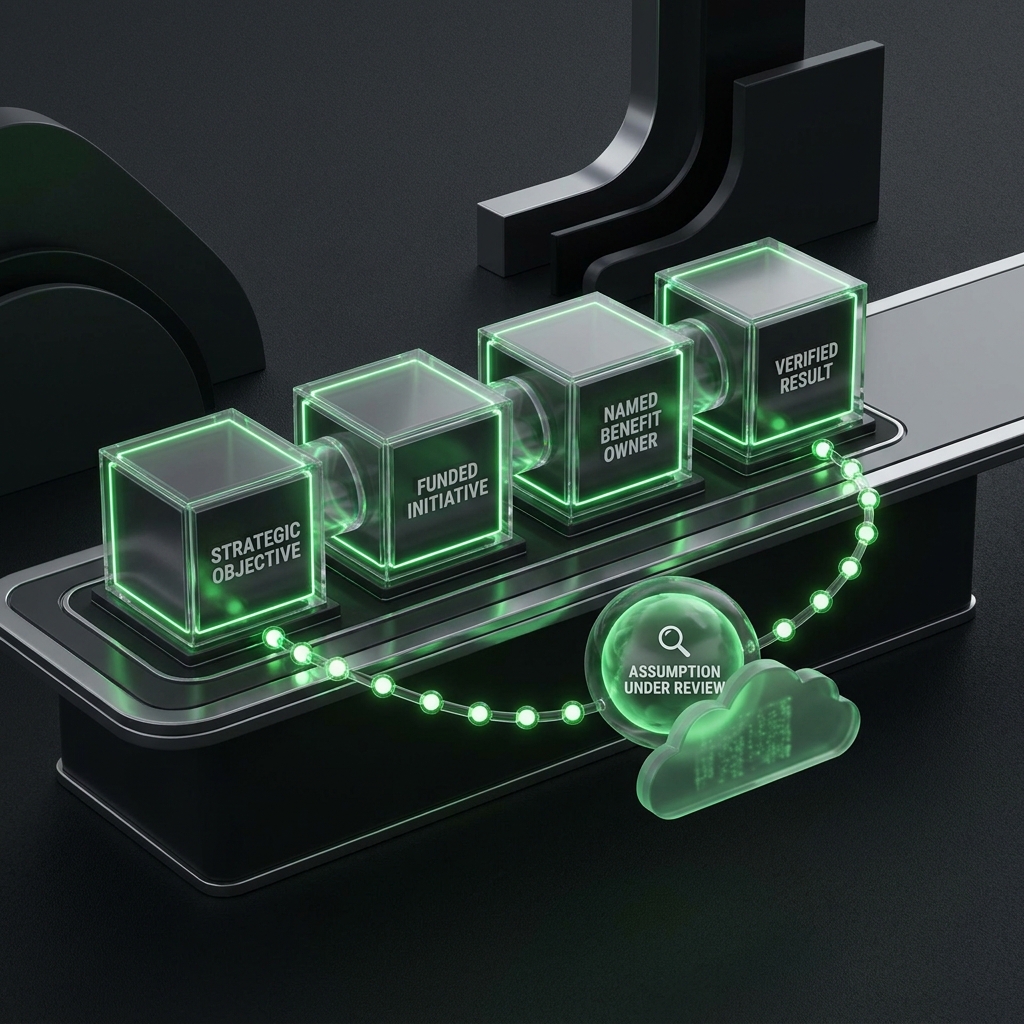
A project can deliver every planned output and still fail to produce the value used to justify its funding. The PMO should track benefits after approval, not retire the case when delivery starts.
The UK Government’s Teal Book describes benefits management as a lifecycle discipline, including identifying, planning, tracking and realising benefits. Its guidance also assigns responsibility for individual benefits to named benefit owners. This is useful practice for any organisation that expects investment to produce measurable outcomes. Teal Book, Benefits management Government Functional Standard GovS 002, Project delivery
Define the benefit before delivery begins
For each expected benefit, write down the outcome, baseline, target or expected range, measurement method, data source, timing and assumptions. Separate an output the project team controls from an outcome that depends on operational adoption or wider conditions.
Name the person who will own the benefit once it is realised. That person should have access to the process, budget or service data needed to measure the result. A project manager can coordinate reporting, but should not be made the owner of a business outcome they cannot control.
Keep the business case live
At agreed review points, compare actual evidence with the original baseline and forecast. Record implementation costs, dependencies, delays and changes in the operating environment. If assumptions have changed, show the impact on the value case rather than quietly moving the target.
A milestone dashboard answers whether tasks are moving. A benefits view asks whether the organisation is getting the outcome it approved. Keep both views, and connect them so leaders can see when delivery status and value status diverge.
Put options in front of the board
When the evidence weakens, present a decision rather than another amber status. The options may be to remove a blocker, change scope, revise the delivery approach, release further funding in stages, pause or stop. Show the cost and expected benefit of each option, with assumptions stated plainly.
Use a consistent portfolio review rhythm. Escalate benefits that lack an owner, have no credible data source, or depend on operational teams that have not committed capacity. These are management decisions, not reporting imperfections.

Close the loop after delivery
Transfer each ongoing benefit into business-as-usual ownership with a review date and evidence source. Close the benefit only when the accountable owner confirms the outcome has been measured and the result is recorded. Where the intended benefit was not achieved, capture the reason and the learning.
A business case is a commitment to test value, not a document to justify a decision already made. Keep the owner, measure and evidence visible. That is how a PMO helps leaders decide where the next pound should go.
✨ Recommended For You
Stop Playing Project Management: Building a PMO That Actually Delivers
A Project Management Office should be a delivery engine, not a department of "no." If your projects are consistently late and over budget, your PMO is failing its primary function: ensuring ROI on change.
PMO Capacity Planning: Why Your Portfolio Is Overcommitted and Nobody Knows It
The UK government's 734-project, £718bn pipeline proves portfolio-level capacity planning works. Your PMO is still allocating resources project-by-project. Here is how to fix it. PMO module from £49/month.
The Traffic Light Trap: Why Your PMO Reporting is Lying to You
RAG statuses are subjective and often misleading. Discover why real-time PMO data is the only metric that matters for portfolio ROI.
Keep project delivery visible
Organise milestones, budgets, owners and RAID logs in Simplif-i.