
M&A Synergies Need P&L Owners
Deal value does not appear because an integration dashboard is green. Assign each synergy to an accountable business owner and reconcile delivery to financial results.
M&A Synergies Need P&L Owners
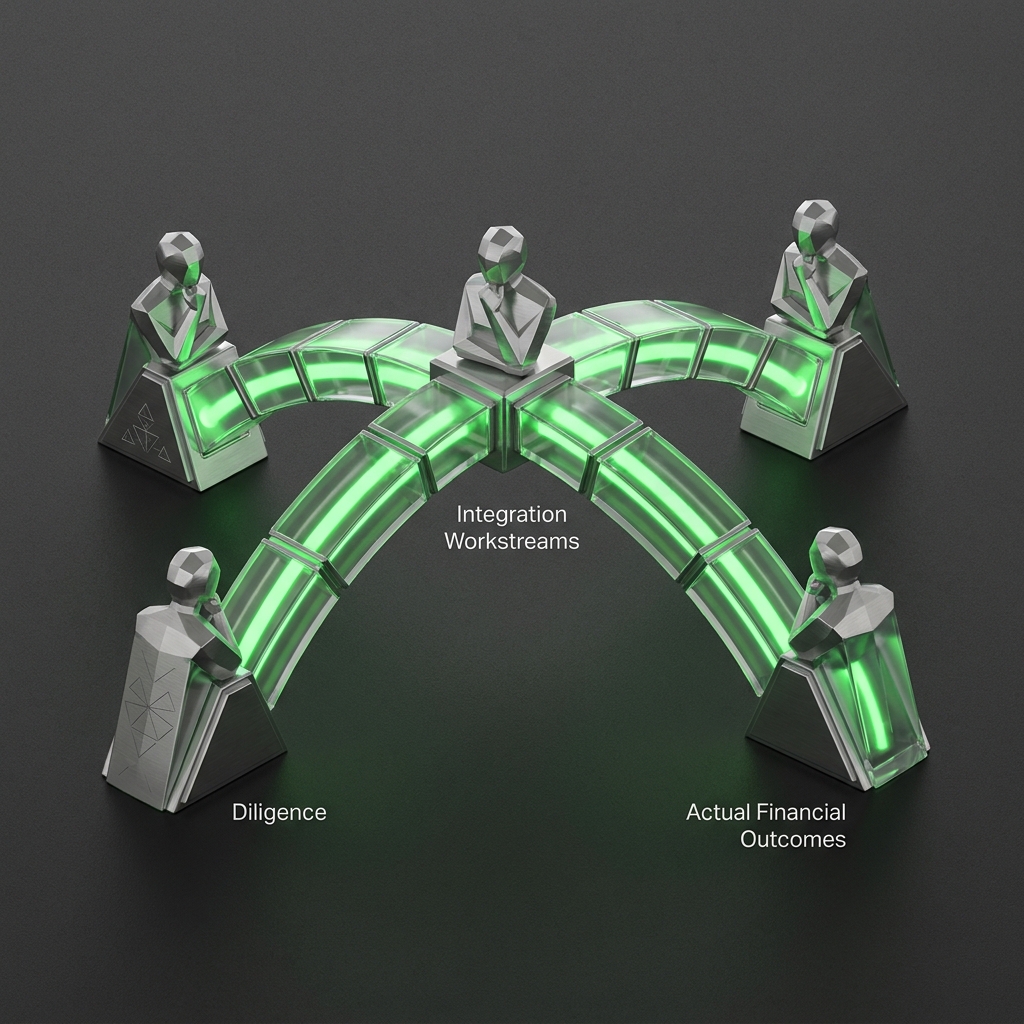
A synergy on a deal slide is an assumption. It becomes value only when a business owner changes how the organisation operates and finance can verify the result.
McKinsey’s guidance on post-close excellence calls for value-based governance that tracks synergy delivery through to financial statements. That is the standard to aim for: connect the deal thesis to accountable actions and realised results, not just a green status report. McKinsey, Post-close excellence in large-deal M&A
Rebuild the baseline after close
For every material value lever, record the diligence assumption, the agreed baseline, how the result will be measured, the timing and the exclusions. Finance should challenge double counting, one-off costs and changes that would have happened without the transaction.
Do not compare a target against a moving reference point. If the baseline changes, explain why, who approved it and what the change does to the deal case. Keep the original thesis visible so leaders can see whether the organisation is delivering the plan or rewriting it.
Name the operator, not just the workstream
Every synergy needs an accountable executive with authority over the relevant people, process or spend. The integration management office can coordinate dependencies, maintain the plan and escalate decisions. It cannot own a business outcome on behalf of a line leader.
Translate the value lever into actions: what changes, who must do it, which decision is needed, what resources are committed and what evidence will show completion. Distinguish a completed task from a financial benefit. A procurement event, system migration or team restructure is not itself proof of value.
Reconcile delivery to the numbers
Review progress with operational owners and finance together. Track forecast, delivered and verified value separately. Explain timing shifts, implementation costs, dependencies and any value lost through delay or a change in scope.
When a workstream is off track, force a decision: remove the blocker, fund a revised route, adjust the forecast with evidence, or stop treating the benefit as achievable. Do not allow a dashboard to hide an ownerless assumption.

Keep the deal thesis in the operating rhythm
The executive team should review the largest value levers until accountability has transferred into normal operations. Close an integration item only when the new process is operating, the owner is clear and the result has been checked against the agreed measure.
The test is blunt: can the accountable leader explain the action, the evidence and the financial consequence? If not, the synergy remains a hypothesis. Keep it out of the victory speech and put it back into the plan.
✨ Recommended For You
Post-Deal Value Capture: Why 70% of M&A Deals Underperform and How to Fix It | Simplif-i
70% of M&A deals fail to deliver expected value. The problem is not due diligence. It is post-deal execution. Learn the operational playbook for value capture in UK mid-market M&A.
Integration Velocity: Why Your Deal Success Depends on Day 0 Automation
M&A deals fail in the integration phase. Discover how Day 0 automation secures deal value and accelerates operational synergy for UK firms.
Deal Debt: Why Your Manual Data Room is Killing Integration
Manual data rooms create 'Deal Debt' that slows down integration and destroys value. Here is how to automate M&A due diligence.
Connect due diligence and integration
Bring due diligence and integration planning together in Simplif-i.