
The Deal Thesis Does Not Close the Deal: Put Integration Owners on the Clock
A deal model is a hypothesis. Protect its value by assigning owners, baselines and decision rights before close, then tracking delivery against evidence.
The Deal Thesis Does Not Close the Deal: Put Integration Owners on the Clock
The acquisition model is a hypothesis. The integration plan is where that hypothesis meets customers, people, systems and operating reality. If the value case has no owner, baseline or decision date, it is not an executable plan.
McKinsey's 2025 guidance on strengthening M&A capability recommends mapping integration costs during diligence and affirming them during integration. That is a useful discipline: carry the assumptions into the workplan, then test them against what the combined business can actually deliver. McKinsey, Five steps to strengthen M&A capabilities
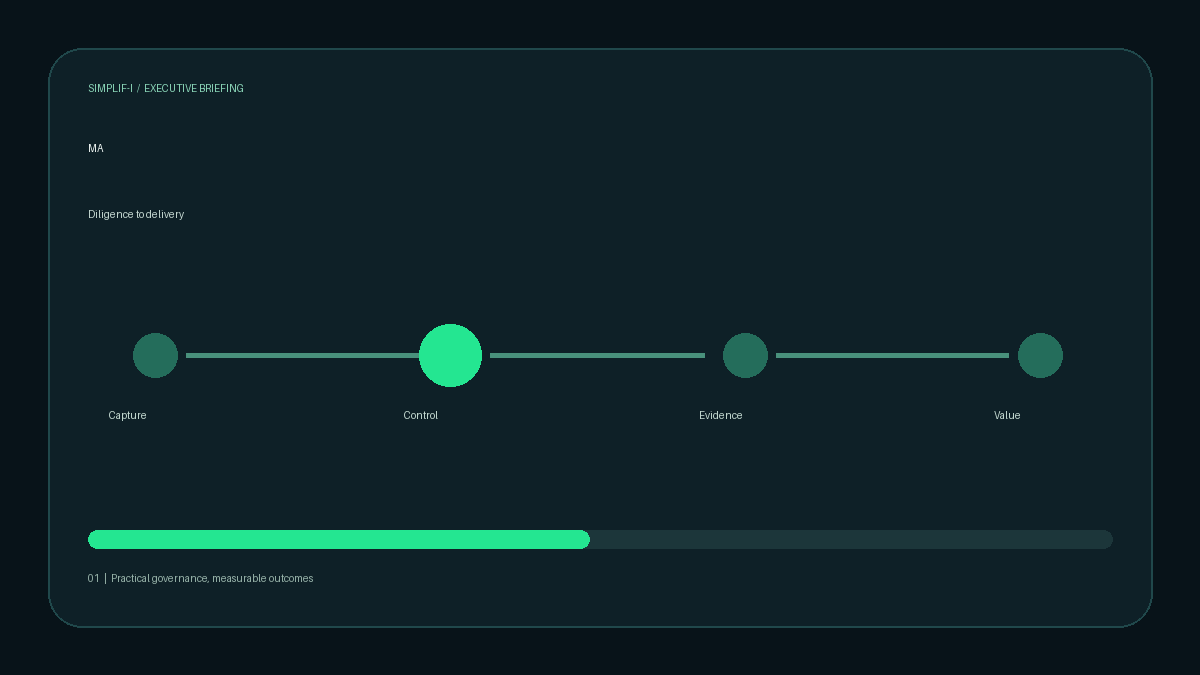
Before close: convert the thesis into work
For each value lever, document the baseline, the intended outcome, the accountable executive, dependencies, one-off costs and the evidence that will prove delivery. Separate confirmed actions from assumptions. If a synergy depends on customer retention, system migration or a regulatory decision, name that dependency explicitly.
Build the integration plan while diligence is still informing the decision. Decide what must be ready on day one, what can wait, and which activities need specialist review. Keep operational preparation within the legal and confidentiality boundaries that apply before completion. Do not let an integration team confuse planning with authority to combine operations.
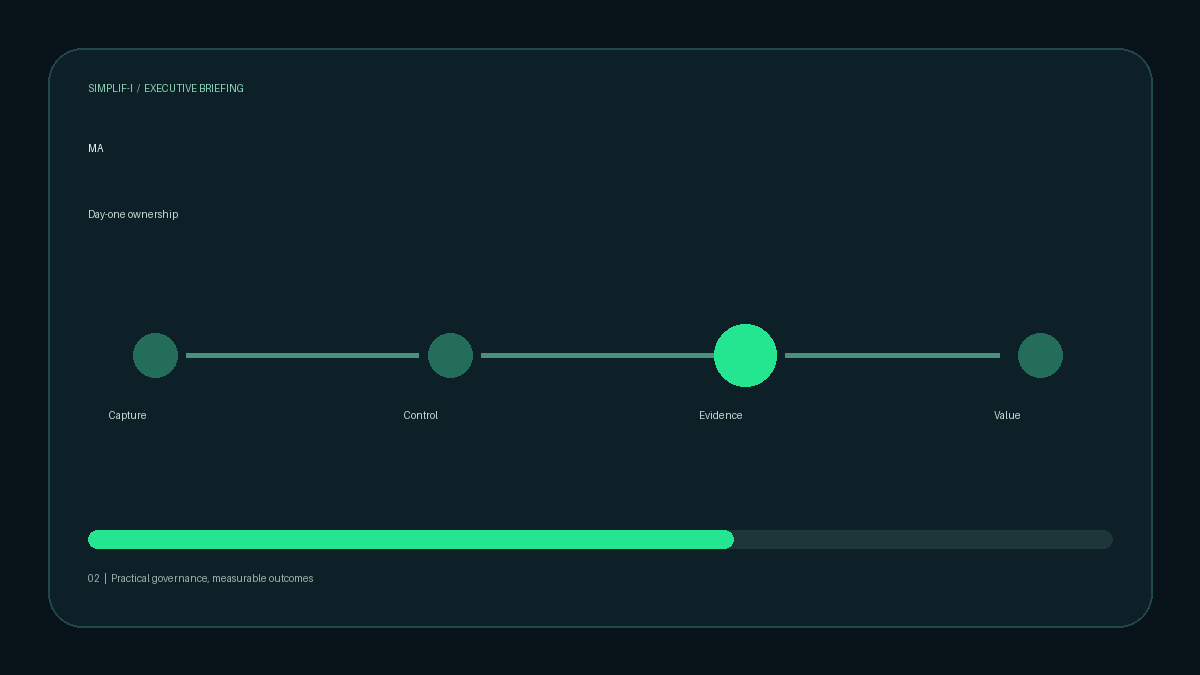
After close: run a delivery cadence
Set a short, consistent review cycle. Each workstream reports progress against its baseline, emerging risks, decisions required and forecast cost to complete. A red status without an owner and a decision request is theatre. Escalate blockers to people who can resolve them, not to a larger slide deck.
Track cost and revenue initiatives separately. Cost actions may require spend before benefits appear. Revenue opportunities may depend on customer consent, product readiness or retention. Record realised benefits only when finance can reconcile them to an agreed baseline and actual results. Keep one-off integration costs visible so that gross savings are not presented as net value.
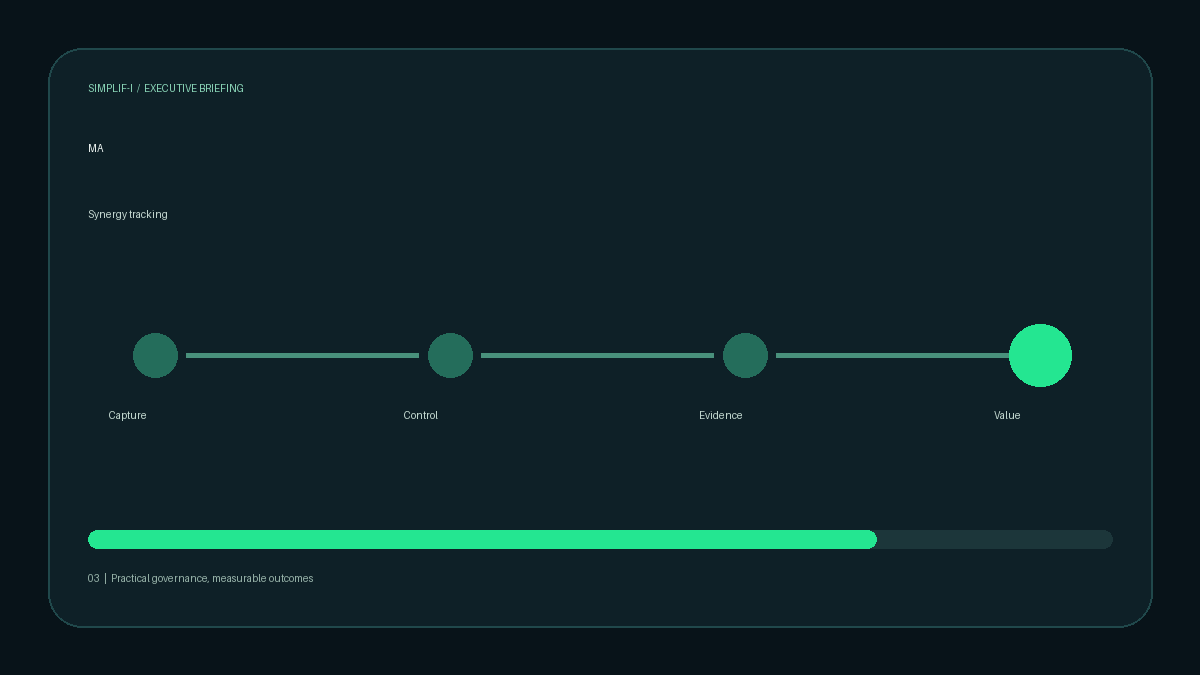
Make the first decisions reversible where possible
Protect continuity first. Identify decisions that are hard to reverse, such as changing customer terms, retiring systems or removing specialist capacity. Require evidence and an accountable approver before those decisions move. Review the operating model against the deal thesis as facts change, and update the forecast rather than defending an obsolete assumption.
Simplif-i's M&A platform describes support for diligence and integration. The practical test is whether your team can move from thesis to owned actions, evidence and decisions without losing sight of the deal economics.
A signed transaction creates the opportunity. Integration discipline determines whether the opportunity survives contact with the business.
✨ Recommended For You
Integration Velocity: Why Your Deal Success Depends on Day 0 Automation
M&A deals fail in the integration phase. Discover how Day 0 automation secures deal value and accelerates operational synergy for UK firms.
The M&A Reality Check: How to Kill Deal Debt Before It Kills Your ROI
Most mergers fail because the due diligence findings never leave the spreadsheet. We call this "Deal Debt." Learn how to bridge the gap between discovery and integration to protect your transaction value.
M&A Integration Planning for UK SMEs: The Operational Playbook That Stops Value Erosion
70% of M&A value is lost in integration. This operational playbook for UK SMEs explains how to stop value erosion using connected platforms instead of spreadsheets.
Connect due diligence and integration
Bring due diligence and integration planning together in Simplif-i.