
Value Protection: Protecting Post-Deal Valuation with Unified Data
Most M&A deals lose value after completion. Learn what value protection means, why unified data is the key to post-deal valuation, and how to stop the integration destroying what you paid for.
You closed the deal. The valuation was agreed. The champagne was opened.
And then the integration started, and the valuation started leaking.
This is the M&A value protection problem. Most acquirers are excellent at deal execution and terrible at deal preservation. The due diligence was thorough. The integration plan was a slide deck. And the operational reality - the contracts, the compliance obligations, the project dependencies, the governance gaps - was discovered too late to protect what was paid for.
What Is Value Protection in M&A?
Value protection is the discipline of preserving the valuation basis of an M&A transaction through the integration period and beyond. It means ensuring that the operational, contractual, compliance, and strategic assumptions that underpinned the deal price remain valid - or are corrected before they erode value.
It is the opposite of the common pattern: due diligence reveals the risks, integration ignores them, and the board discovers the valuation was optimistic 18 months later.
Why Do Most Deals Lose Value Post-Completion?
Because the data that drove the deal is not the data that drives the integration. Specifically:
- Due diligence data is static. It captures a snapshot. The target's operations keep moving after the data room closes.
- Integration data is fragmented. Contracts are in one system. Compliance is in another. PMO tracking is in a third. HR is in a fourth. Nobody has the full picture.
- Risk data is disconnected. The risks identified in due diligence are not linked to the integration plan. A compliance gap flagged in the VDR is not tracked as an integration workstream.
- Change of control clauses trigger silently. Key contracts may contain change of control provisions that allow counterparties to terminate or renegotiate. If these are not tracked operationally, the revenue base erodes.
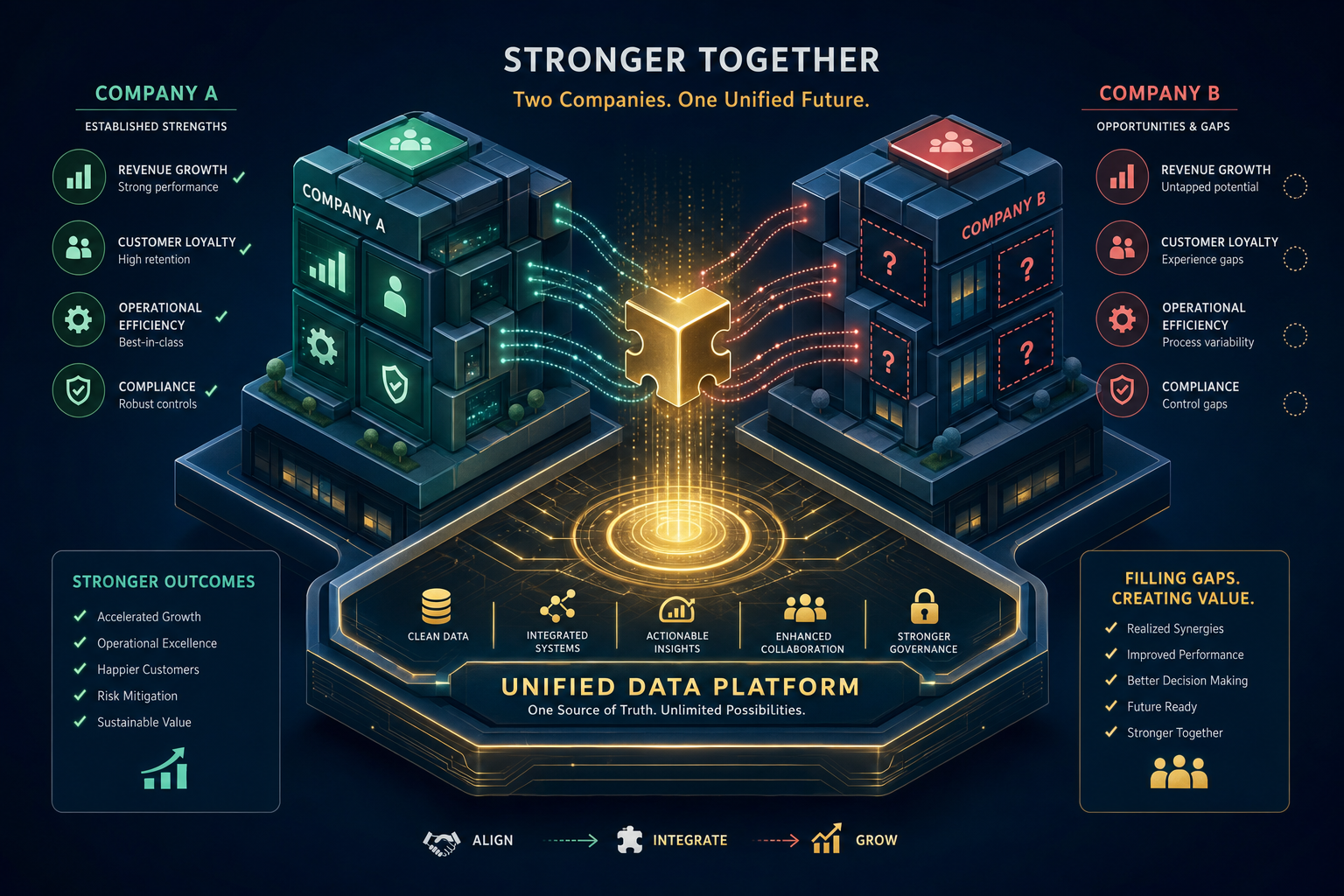
Value protection requires a unified data platform that connects due diligence findings to integration workstreams in real time.
What Does Unified Data Mean in Post-Deal Integration?
Unified data means a single operational layer that connects all integration workstreams - GRC, Contracts, PMO, Company Secretarial, and compliance - into one platform. It is the antidote to the fragmented integration that destroys value.
In practice, unified data means:
- Every due diligence finding is tracked as an integration action item - with an owner, a deadline, and a link to the affected risk or objective.
- Every material contract is mapped to the integration plan - with change of control clauses, renewal dates, and obligation summaries visible in one view.
- Every compliance obligation - GDPR, ISO 27001, sector-specific requirements - is tracked as a live control, not a static finding.
- Every statutory filing requirement for the acquired entity is managed through the Company Secretarial module - director changes, PSC updates, registered office amendments.
- The board sees a single integration dashboard - not five separate workstream reports stitched together in PowerPoint.
How Do You Build a Value Protection Framework?
- Start in due diligence. Use the due diligence phase to build the integration data model - not just the risk report. Every finding should have a clear route to an integration workstream.
- Map contracts to the integration plan. Identify all material contracts, extract key obligations, flag change of control clauses, and link them to integration milestones.
- Connect GRC from Day 1. The acquired entity's compliance obligations must be visible in the acquirer's GRC framework immediately - not "when we get round to it."
- Track integration in the PMO module. Integration milestones, dependencies, and resource allocation should be managed alongside the acquirer's existing portfolio - so the board can see the full picture.
- Update statutory records immediately. Director changes, PSC updates, and registered office amendments must be filed accurately and on time. Under ECCTA, the margin for error is shrinking.
The Bottom Line
You did not pay that valuation to watch it erode in a fragmented integration. Every disconnected spreadsheet, every untracked contract, every compliance gap that goes unmonitored is value walking out the door.
Unified data is not a nice-to-have. It is the mechanism by which you protect what you paid for.
Simplif-i's M&A Pro+ module connects due diligence findings to integration workstreams, contracts to risk registers, and compliance obligations to board reports. One platform. One view. One version of the truth.
Founding Member pricing: £149/month. A rounding error on your deal fee - and the difference between protecting value and hoping for the best.
✨ Recommended For You
Post-Deal Value Capture: Why 70% of M&A Deals Underperform and How to Fix It | Simplif-i
70% of M&A deals fail to deliver expected value. The problem is not due diligence. It is post-deal execution. Learn the operational playbook for value capture in UK mid-market M&A.
Deal Debt: Why Your Manual Data Room is Killing Integration
Manual data rooms create 'Deal Debt' that slows down integration and destroys value. Here is how to automate M&A due diligence.
The M&A Reality Check: How to Kill Deal Debt Before It Kills Your ROI
Most mergers fail because the due diligence findings never leave the spreadsheet. We call this "Deal Debt." Learn how to bridge the gap between discovery and integration to protect your transaction value.
Connect due diligence and integration
Bring due diligence and integration planning together in Simplif-i.