# Outcome Portfolio Management: Beyond the Status Report
**Category:** PMO
**Author:** John Hotham
**Published:** 2026-05-27
**Read Time:** 7 min read
## Summary
Your PMO produces status reports. It should produce strategic intelligence. Outcome portfolio management replaces activity measurement with value measurement. The difference is the difference between a cost centre and a strategic function.
## Full Content
Let us be direct: if your PMO's primary output is a weekly status report, it is not a strategic function. It is an administrative one. And you are paying strategic-function money for administrative-function output.
Outcome portfolio management is the corrective. It does not ask "Are we on time?" It asks "Are we delivering value?" Those are fundamentally different questions, and they require fundamentally different tools.
## What Is Outcome Portfolio Management?
**Definition:** **Outcome portfolio management** is the practice of governing a portfolio of initiatives by measuring the business outcomes they deliver (revenue generated, cost avoided, risk reduced, capability gained) rather than the activities they complete (tasks finished, milestones hit, budget spent). It treats every project as an investment with an expected return, and it tracks that return as rigorously as a fund manager tracks portfolio performance.
The traditional PMO measures activity: percentage complete, tasks delivered, RAG status. These are inputs. They tell you nothing about whether the investment is paying off.
An outcome-focused PMO measures results: customer acquisition cost reduced, revenue per employee increased, time-to-market shortened, compliance gap closed. These are outputs. They tell the board whether the portfolio is delivering on its strategic thesis.
## Why Do Most PMOs Get Stuck on Status Reporting?
Because status reporting is easy. A Gantt chart with coloured bars is simple to produce and simple to consume. It gives the board something to look at without requiring them to make difficult decisions.
Outcome measurement is hard. It requires:
1. **Clear outcome definitions at initiation** — What does success look like in measurable terms? Not "implement new CRM" but "reduce customer churn by 12% within 9 months of go-live."
2. **Baseline measurement** — What is the current state? You cannot measure improvement without knowing where you started.
3. **Ongoing outcome tracking** — Not just at project close. During delivery. Are leading indicators showing that the outcome is achievable?
4. **Portfolio-level aggregation** — What is the total value being generated across all initiatives? Where is value concentrating? Where is it failing to materialise?
Most PMOs avoid this because it creates accountability. A project that is RAG Green but failing to deliver its outcome is exposed. A project that is RAG Amber but demonstrably delivering value is protected. Outcome measurement changes the politics of portfolio governance.
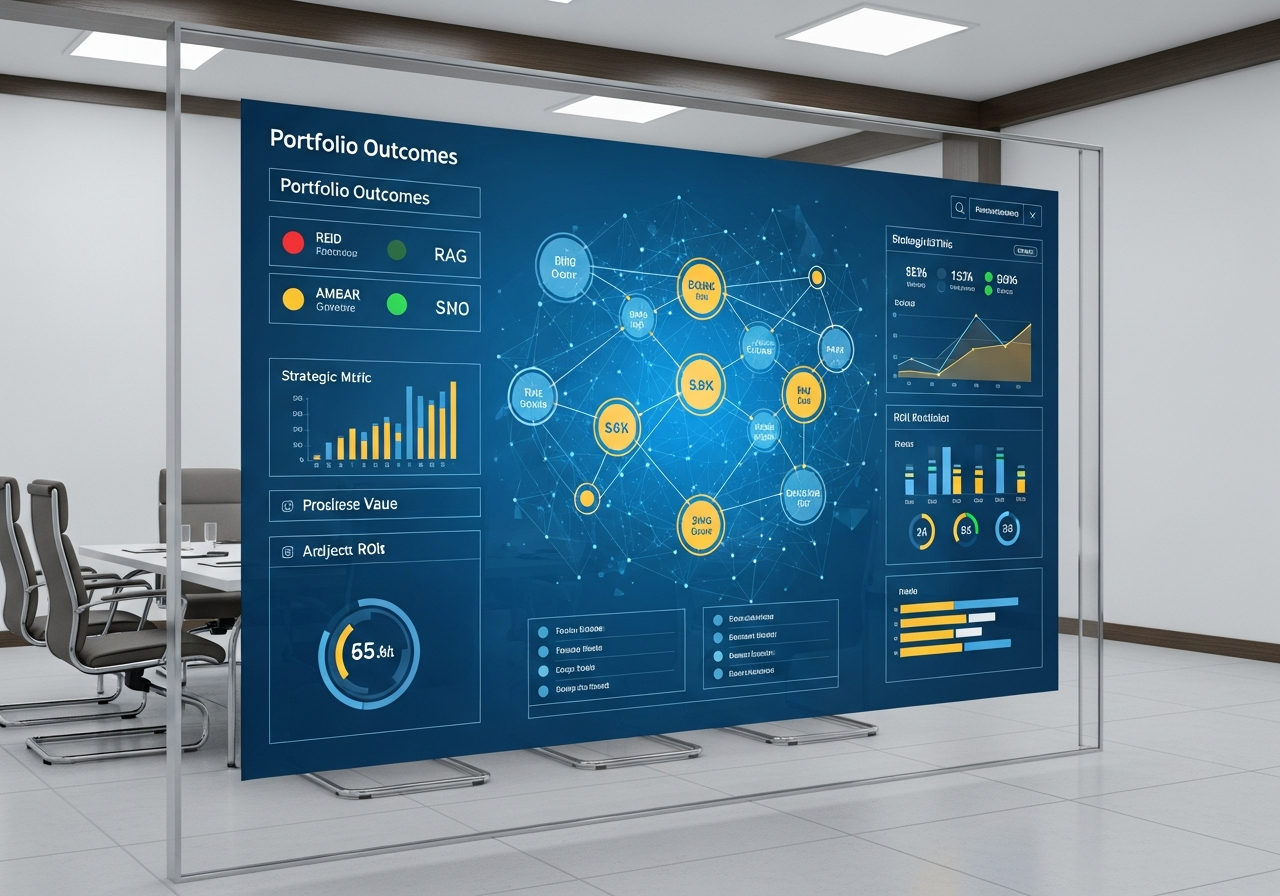
## What Does an Outcome-Focused PMO Dashboard Look Like?
1. **Value delivered to date** — Across the portfolio, how much measurable business value has been realised? Not projected. Realised.
2. **Value at risk** — Which initiatives are showing leading indicators of outcome failure? What is the monetary exposure?
3. **Investment efficiency** — For every £1 spent across the portfolio, how much value has been returned? What is the portfolio's current return rate?
4. **Outcome drift** — Which initiatives have changed their outcome definition since initiation? (This is a governance red flag.)
5. **Strategic alignment score** — What percentage of portfolio spend is directed at board-level strategic objectives versus BAU maintenance?
## Simplif-i vs. The Field: PMO Comparison Table
| Dimension | Simplif-i (Outcome Portfolio Management) | Traditional PMO Tools (The Field) |
|---|---|---|
| Primary metric | Business outcomes delivered (revenue, cost, risk, capability) | Activity completed (tasks, milestones, percentage) |
| Portfolio view | Value concentration map showing where returns are materialising | Gantt chart aggregation showing timeline adherence |
| Board reporting | Outcome realisation vs investment. Strategic ROI | RAG status summary. Timeline and budget variance |
| Risk integration | Native. Project risks connect to enterprise risk register and contract obligations | None. Project risk is siloed within the project tool |
| Contract linkage | Native. Delivery milestones tied to contract obligations and penalty clauses | None. Contracts managed in separate CLM tool |
| Governance routing | Outcome failure triggers governance escalation automatically | Manual. PM escalates when they choose to |
| Strategic alignment | Tracked. Every initiative maps to a board objective with weighted contribution | Assumed. Alignment stated at initiation, never measured |
| Kill decisions | Data-driven. Outcome metrics trigger review thresholds | Political. Nobody wants to kill their project |
| Resource allocation | Directed by outcome performance. Invest in what delivers | Directed by plan. Resources follow the Gantt chart |
| Cross-module visibility | PMO sees GRC, Contracts, CoSec, and M&A signals | PMO sees only what is inside the PM tool |
| Pricing | £149/month Founding Member (full platform including PMO, GRC, Contracts, M&A, CoSec) | £5,000-£15,000/year (PMO tool only, no cross-module) |
## How Do You Transition from Status Reporting to Outcome Management?
### Step 1: Define Outcomes at Initiation
Every new initiative must have a measurable outcome defined before it enters the portfolio. Not a deliverable. An outcome. "Deploy ERP" is a deliverable. "Reduce month-end close from 12 days to 5 days" is an outcome.
### Step 2: Establish Baselines
Measure the current state of every outcome metric before the initiative begins. Without a baseline, you cannot prove improvement. And if you cannot prove improvement, you cannot justify the investment.
### Step 3: Track Leading Indicators During Delivery
Do not wait until project close to measure outcomes. Identify leading indicators that predict outcome achievement and track them monthly. If a CRM implementation aims to reduce churn, track early adoption rates, data quality scores, and user engagement during delivery.
### Step 4: Connect to Commercial Reality
Outcomes do not exist in a vacuum. They connect to contracts (delivery obligations, SLA commitments), to risk (what happens if the outcome is not achieved), and to governance (which board objective does this serve). A PMO that tracks outcomes in isolation is better than one that tracks tasks, but still incomplete.
### Step 5: Make Kill Decisions
An outcome-focused PMO will inevitably identify initiatives that are on time, on budget, and failing to deliver value. These initiatives must be killed. The money and people must be redirected to initiatives that are demonstrably delivering. This is the hardest part. It is also where the strategic value lives.
## What Happens When You Connect PMO to GRC, Contracts, and M&A?
The real power of outcome portfolio management emerges when it connects to the rest of your operational governance:
- **GRC connection:** A project delivering a compliance outcome (closing a gap, achieving certification) has its outcome tracked against the live compliance score. Not a separate metric. The actual framework score.
- **Contract connection:** A project with delivery obligations in a client contract has its milestones linked to penalty clauses. Miss the milestone, see the financial exposure immediately.
- **M&A connection:** Post-merger integration projects have synergy realisation tracked as outcomes. The deal thesis becomes a live portfolio metric, not a slide deck from six months ago.
This is not a feature wish list. This is how Simplif-i works today. One platform. Every module connected.
## The Bottom Line
Status reports tell the board what happened last week. Outcome management tells the board whether the portfolio is delivering on its strategic investment thesis. One is retrospective admin. The other is forward-looking governance.
If your PMO cannot answer "What value did we deliver this quarter?" with a number, it is a status reporting factory. And you are paying too much for it.
**Simplif-i** connects your PMO to your GRC, Contracts, M&A, and CoSec in one platform. Outcome measurement with full operational context. Founding Member pricing: **£149/month**.
[Start your free trial at Simplif-i.com](https://simplif-i.com/signup)
---
---
Source: https://simplif-i.com/api/blog/readable/pmo/outcome-portfolio-management-beyond-status-report-2026
Web Version: https://simplif-i.com/blog/pmo/outcome-portfolio-management-beyond-status-report-2026
© Simplif-i - Unified Business Management Platform