I get asked this question at least twice a month, usually by a CFO or general counsel who has just discovered that their GRC platform has no idea how many legal entities the group actually contains. The conversation always starts the same way: "We bought a GRC tool. Why does it not manage our entities?"
The short answer is that GRC software and entity management software were designed to solve fundamentally different problems. The longer answer is that both are necessary, neither is sufficient on its own, and the space between them is exactly where governance failures occur. Let me walk through this properly.
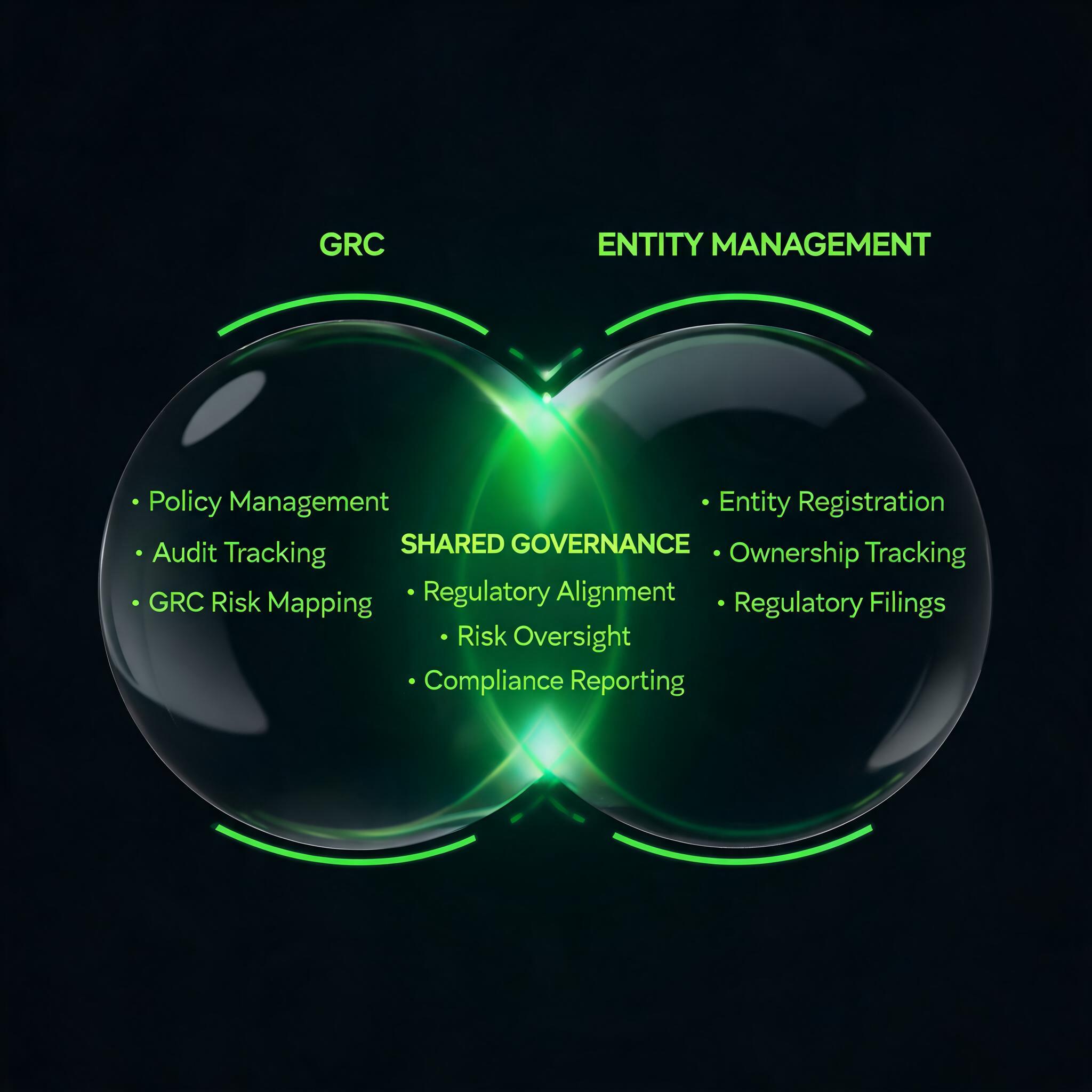
GRC (Governance, Risk, and Compliance) software is built around three core functions:
Risk Management: The platform maintains a risk register, typically structured around risk categories (operational, financial, strategic, compliance, reputational). Each risk has an owner, a likelihood score, an impact score, a set of mitigating controls, and a review cycle. The platform enables risk assessment workshops, heat map generation, risk appetite threshold monitoring, and board-level risk reporting.
Compliance Management: The platform maps regulatory requirements to internal controls, tracks control effectiveness through testing cycles, manages policy libraries, and generates compliance status reports against frameworks such as ISO 27001, SOC 2, GDPR, FCA regulations, and sector-specific requirements. Compliance gaps are flagged, remediation plans are tracked, and audit trails are maintained.
Audit Management: The platform supports internal audit planning, fieldwork management, finding tracking, and management action follow-up. It provides a structured workflow from audit universe definition through engagement planning, testing, reporting, and closure.
The market leaders in this space (ServiceNow GRC, Archer, Diligent, OneTrust, LogicGate, Riskonnect) have spent years refining these three capabilities. They are good at what they do. What they do not do is manage legal entities.
Entity management software is built around a completely different data model. Its primary object is the legal entity: a company, partnership, trust, or other legal structure that exists as a registered entity in one or more jurisdictions. The core functions are:
Entity Lifecycle Management: Tracking every entity from incorporation through active trading, dormancy, and eventual dissolution or strike-off. This includes maintaining formation documents, certificates of incorporation, constitutional documents (articles of association, partnership agreements), and registration details across jurisdictions.
Corporate Structure Visualisation: Mapping the ownership relationships between entities in a group, including direct and indirect shareholdings, minority interests, joint ventures, and nominee arrangements. For a group with 50 entities across 12 jurisdictions, this is not a PowerPoint diagram. It is a live data model that updates when share transfers occur or new entities are formed.
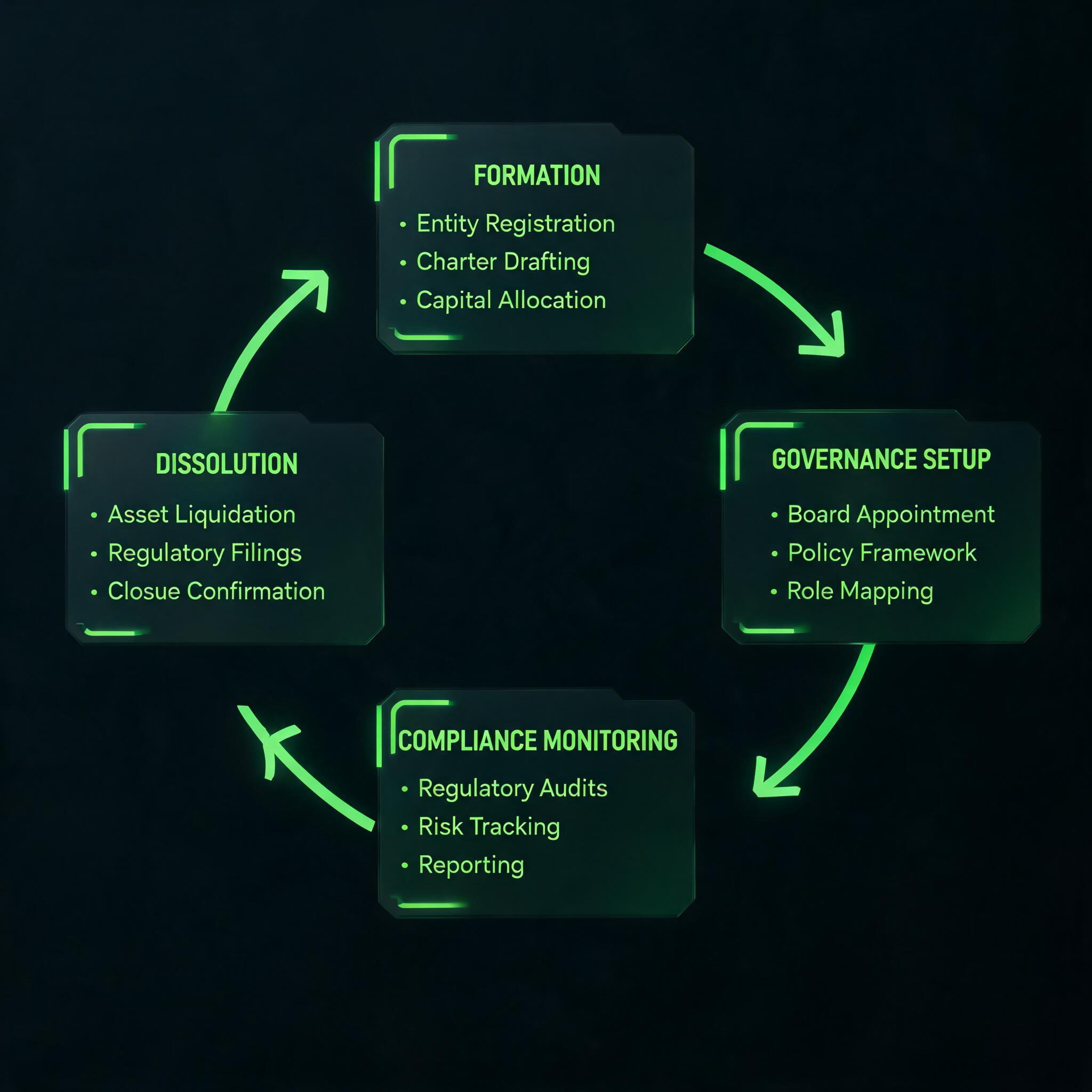
Officer and PSC Management: Tracking director appointments, resignations, and changes of particulars across every entity in the group. In the UK, this includes PSC (Persons with Significant Control) register maintenance with mandatory 14-day filing windows for changes. For multinational groups, officer management must account for jurisdiction-specific requirements: nationality and residence disclosures, local director requirements, and qualification restrictions.
Statutory Compliance: Managing the filing obligations that each entity owes to its local registrar. Annual returns, confirmation statements, financial statement filings, registered office changes, share capital alterations, and special resolution filings. Each obligation has a jurisdiction-specific deadline calculation and penalty regime.
Statutory Register Maintenance: Maintaining the registers that companies are legally required to keep: register of members, register of directors, register of secretaries, register of charges, register of PSCs. These are not optional documentation. They are legal requirements with inspection rights for regulators and, in some cases, the public.
The specialist entity management market includes products like Diligent Entities, EntityKeeper, Blueprint OneWorld, Corporatica, and Athennian. These tools are purpose-built for the legal and company secretarial function.
There is a genuine overlap between GRC and entity management in one area: governance. Both categories of software claim to support governance, but they define it differently.
GRC software defines governance as the framework of policies, procedures, and oversight mechanisms that direct and control an organisation. It manages governance at the programme level: governance frameworks, governance committees, governance reporting.
Entity management software defines governance as the legal and administrative mechanics of running corporate entities: board meetings, director appointments, shareholder resolutions, constitutional compliance. It manages governance at the entity level.
Neither definition is wrong. Both are incomplete. And the gap between them is exactly where governance failures live.
Here is a scenario I encounter regularly during audits:
A PE-backed group acquires a target company. The M&A team completes the deal. The GRC team updates the risk register to reflect the new entity's risk profile (based on whatever information was captured during due diligence). The company secretarial team adds the entity to their entity management system and begins managing its filing obligations.
Six months later, an audit reveals that:
None of these failures are caused by bad software. They are caused by disconnected software. The GRC platform does not know the entity exists in operational terms. The entity management platform does not know the risk register exists. And nobody owns the space between them.
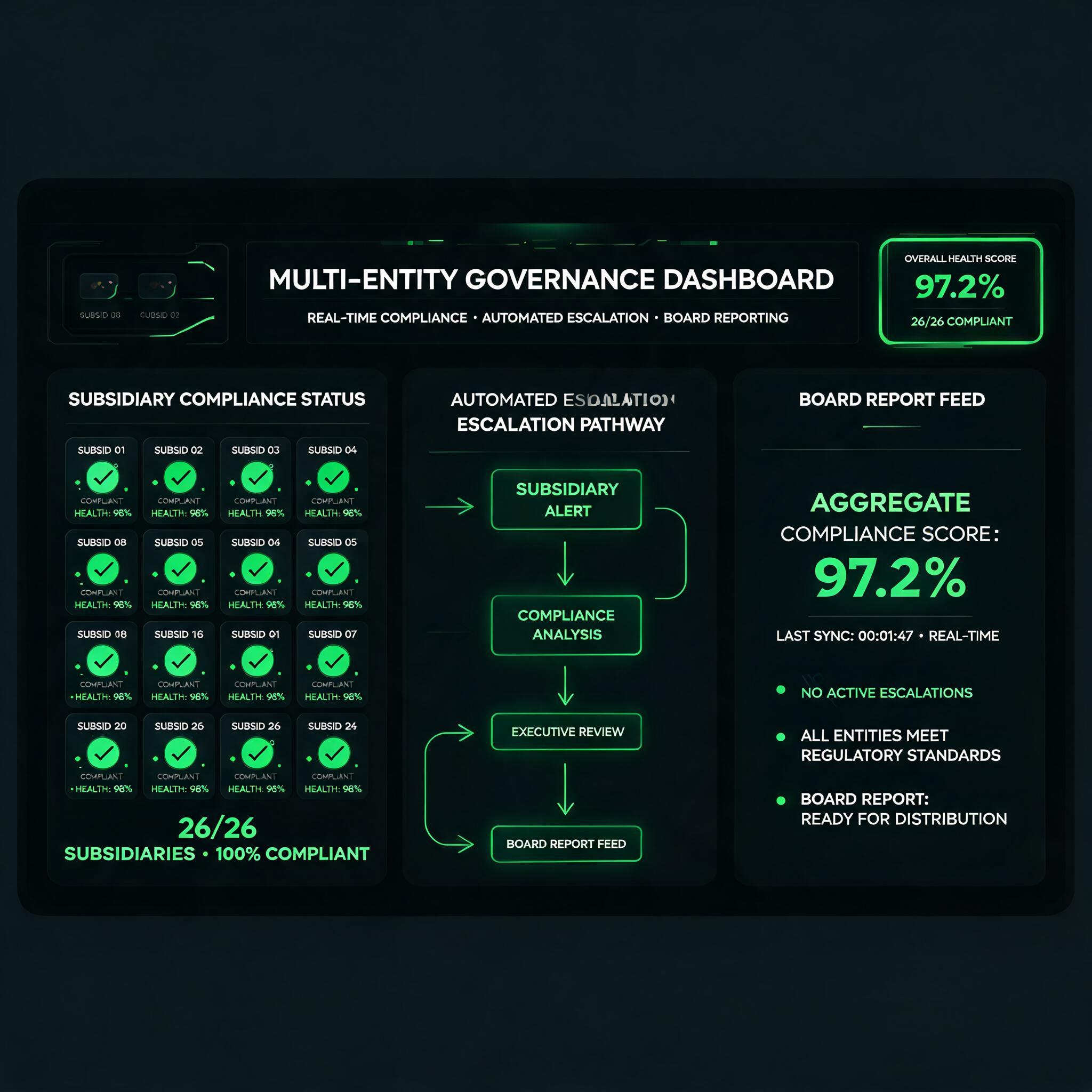
The instinctive response from most technology teams is integration: build an API connection between the GRC platform and the entity management platform so data flows between them. In theory, this closes the gap. In practice, it creates a new set of problems:
Data model mismatch. GRC platforms model risks, controls, and compliance requirements. Entity management platforms model legal entities, officers, and filing obligations. There is no natural primary key between these data models. An "entity" in GRC might be an organisational unit, a business unit, or a legal entity, depending on how the platform was configured. An "entity" in the entity management system is always a legal entity. Mapping between these requires a translation layer that someone has to build and maintain.
Event interpretation. When a director resigns from a subsidiary, the entity management system records the event and triggers a Companies House filing. But what does the GRC platform do with that event? Is it a risk? If so, what category? What severity? Who owns it? These interpretations require business logic that does not exist in a simple API integration. It requires an intelligence layer that understands the governance implications of entity-level events.
Maintenance burden. API integrations between enterprise platforms are not set-and-forget. They break when either platform updates its API, when data models change, when new entity types are added, or when regulatory requirements shift. The integration becomes a permanent maintenance liability that typically falls to whichever team has the least capacity to manage it.
This is why point-to-point integration between GRC and entity management is a workaround, not a solution. The real answer is a unified data model that treats entities, risks, controls, compliance obligations, and governance events as first-class objects in a single architecture.
The approach we built into Simplif-i is called Automated Risk Injection, and it works on a simple principle: every event that occurs in the entity management layer automatically generates or updates a risk entry in the GRC layer. There is no integration to maintain because there is no gap to bridge. Both layers share the same data model.
When a director resigns, the system simultaneously:
This happens in real time, without manual intervention, because the entity event and the risk event are expressions of the same underlying governance event in a single system. There is no API call. There is no translation layer. There is no mapping exercise. The data model was designed to capture both dimensions from the start.
If you are evaluating software in this space, here is the framework I recommend:
If you have fewer than five entities and limited M&A activity, a standalone GRC platform with manual entity tracking may be sufficient. The governance gap is manageable with disciplined processes.
If you have 5 to 20 entities or are growing through acquisition, you need both GRC and entity management capabilities, and they need to share data. A point-to-point integration may work, but budget for ongoing maintenance and accept that the gap will produce governance blind spots.
If you have 20+ entities, operate across multiple jurisdictions, or acquire regularly, you need a unified platform where entity management and GRC share a single data model. Integration is not enough. You need Automated Risk Injection: the ability for entity events to generate risk events automatically, without human intervention or middleware.
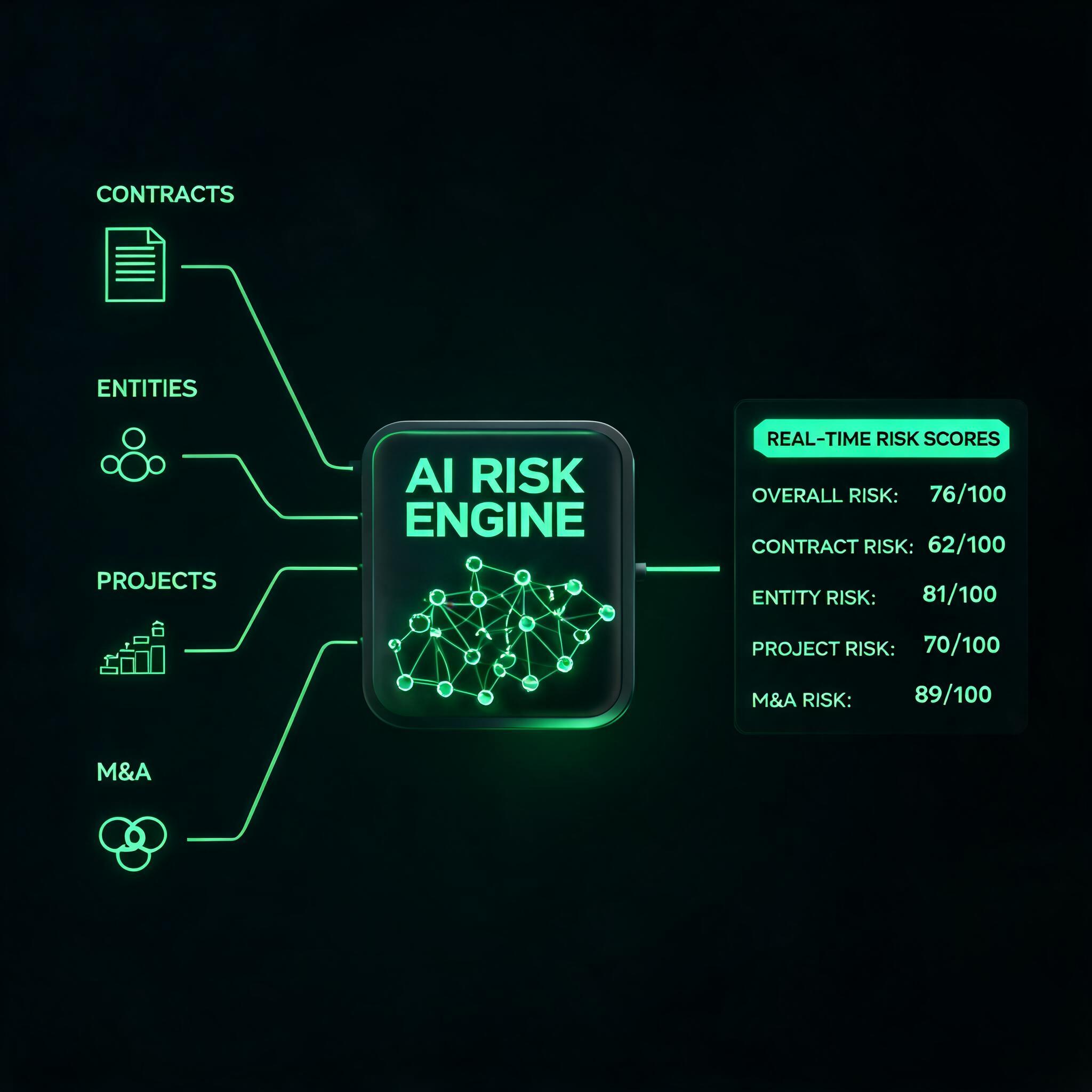
Simplif-i is not a GRC tool. It is not an entity management tool. It is a governance operating system that contains both, plus contract management, M&A integration, and PMO governance, in a single architecture with a single data model and a single risk framework.
Every entity event, every contract event, every M&A milestone, and every project governance checkpoint flows through Automated Risk Injection into one risk register, with one set of controls, one escalation framework, and one board reporting channel.
The question is not whether you need GRC or entity management. You need both. The question is whether you want them in two systems with a fragile integration between them, or in one system where the architecture was designed to treat governance as a single, connected discipline.
Compliance, simplif-i'd.
--- Source: https://simplif-i.com/api/blog/readable/grc/grc-vs-entity-management-software-difference Web Version: https://simplif-i.com/blog/grc/grc-vs-entity-management-software-difference © Simplif-i - Unified Business Management Platform