Let me state the problem plainly. Your GRC platform manages governance, risk, and compliance. Your contracts are the single largest source of governance obligations, risk exposure, and compliance requirements in your organisation. Yet your GRC platform almost certainly does not contain your contract data, does not parse your contract clauses, and does not generate risk entries from your contractual obligations.
This is not a technology limitation. It is a design choice. GRC vendors built their platforms around risk registers, control frameworks, and compliance mappings. They assumed that contract data would live somewhere else, managed by someone else, and that the relevant risks would be manually entered by a risk analyst who had somehow read and understood every material contract in the organisation. That assumption was wrong in 2010, and it is indefensible in 2026.
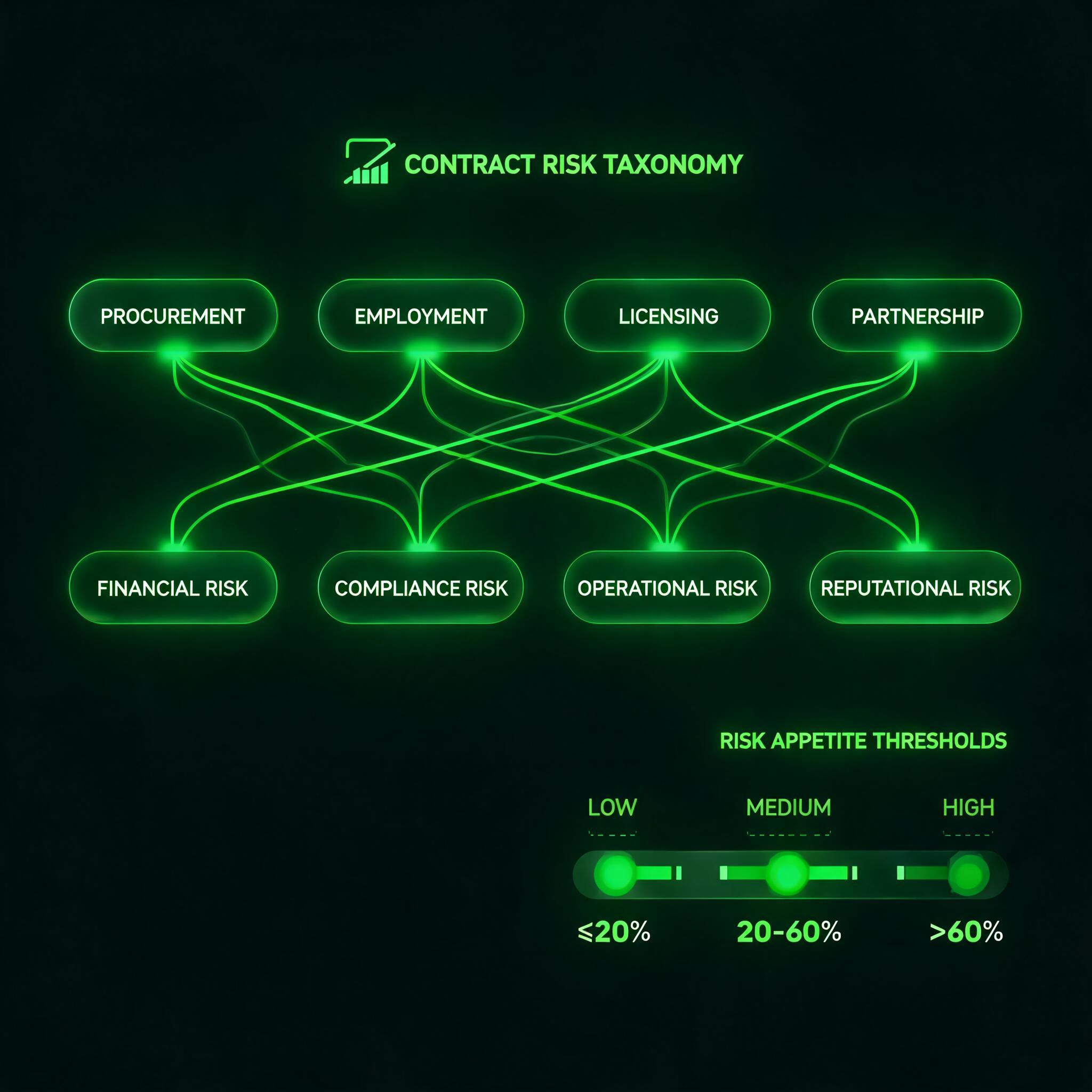
Every board sets a risk appetite statement. It defines the level and type of risk the organisation is willing to accept in pursuit of its objectives. But the actual risk appetite of an organisation is not defined by a statement. It is defined by the contracts it signs.
When your procurement team signs a supplier contract with an uncapped indemnity, they have accepted unlimited financial risk on behalf of the organisation, regardless of what the risk appetite statement says. When your commercial team agrees to a customer SLA with a response time that your operations cannot reliably deliver, they have accepted performance risk that the risk register does not capture.
If contract data is not visible in the GRC platform, the board cannot compare its stated risk appetite with its actual risk exposure. The risk appetite statement becomes a governance artefact rather than a management tool.
Most GRC platforms track compliance against external regulatory frameworks: GDPR, ISO 27001, FCA requirements, health and safety regulations. But your organisation also has compliance obligations that arise from its contracts: data processing requirements in supplier agreements, audit rights in outsourcing contracts, performance benchmarks in customer SLAs, financial covenants in loan agreements, reporting obligations in partnership arrangements.
These contractual compliance obligations are legally binding and financially material. A breach of a financial covenant can trigger a loan recall. A breach of a data processing clause can result in regulatory action against both parties. A breach of a customer SLA can trigger penalty payments that erode margins.
If these obligations are not tracked in the GRC platform alongside regulatory compliance obligations, the organisation's compliance posture is understated. The compliance dashboard shows green, but 40% of the organisation's binding obligations are invisible because they originate from contracts rather than regulations.
Your GRC platform contains a control framework: a set of controls designed to mitigate identified risks to acceptable levels. Many of those controls depend, directly or indirectly, on contractual arrangements.
Your business continuity control relies on a disaster recovery service provided under a supplier contract. If that contract has a 24-hour recovery time commitment but your business impact analysis requires 4-hour recovery, the control is ineffective. But the control assessment in the GRC platform rates the control as "effective" because the assessor tested whether the DR contract exists, not whether its terms are adequate.
Your data protection control relies on data processing agreements with every third-party processor. If three of your 40 DPAs are missing the mandatory Article 28 clauses, those controls are non-compliant. But the control assessment rates them as effective because the assessor counted the number of DPAs on file without reading them.
When contract data lives inside the GRC platform, control assessments can be performed against actual contract terms rather than the assumption that a contract exists and is adequate. This is the difference between governance theatre and governance practice.
Enterprise risk management depends on the ability to aggregate risks across the organisation. If your risk register contains 150 risks across 10 categories, the board needs to understand the total exposure in each category, the concentration of risk in specific areas, and the interdependencies between risks.
Contract risks cut across every risk category. A single supplier contract might contribute to financial risk (through pricing terms), operational risk (through service levels), compliance risk (through data processing obligations), and strategic risk (through exclusivity clauses that limit your flexibility). If these contract-derived risks are not in the risk register, the aggregation is incomplete and the board's view of total exposure is understated.
More critically, concentration risk cannot be assessed without contract data. If five of your most critical operational processes depend on contracts with the same supplier, that is a concentration risk that only becomes visible when contract data and risk data are combined. The GRC platform sees five separate operational risks. Only by linking them to their underlying contracts can the concentration pattern be identified.
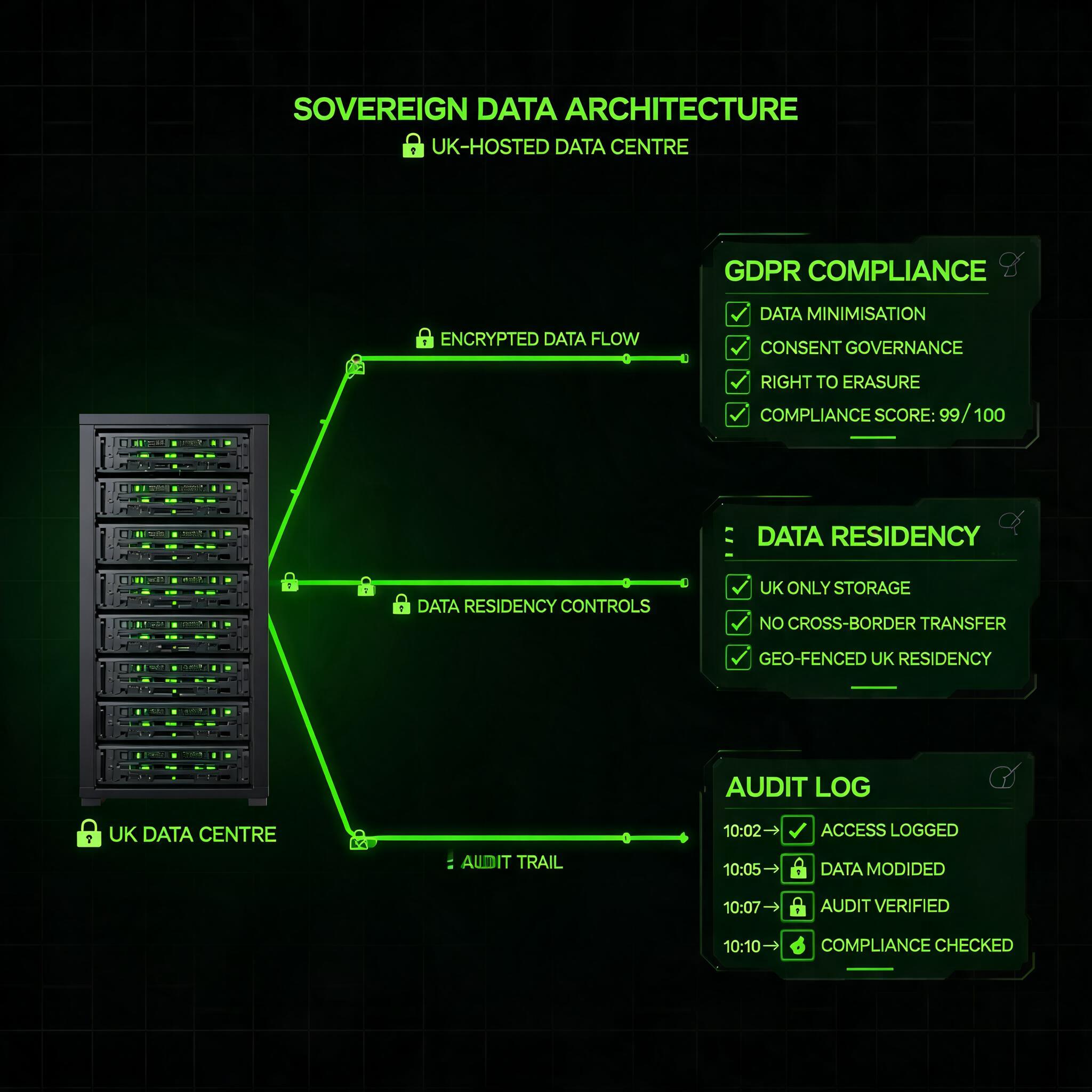
Internal and external auditors increasingly expect to trace from a risk in the register to its source, through the controls designed to mitigate it, to the evidence that those controls are operating effectively. When contract risks are manually entered into the GRC platform, the audit trail breaks at the point of entry. The auditor can see the risk entry but cannot navigate to the contract clause that generated it, the risk assessment methodology that scored it, or the contract monitoring process that confirms the risk is being managed.
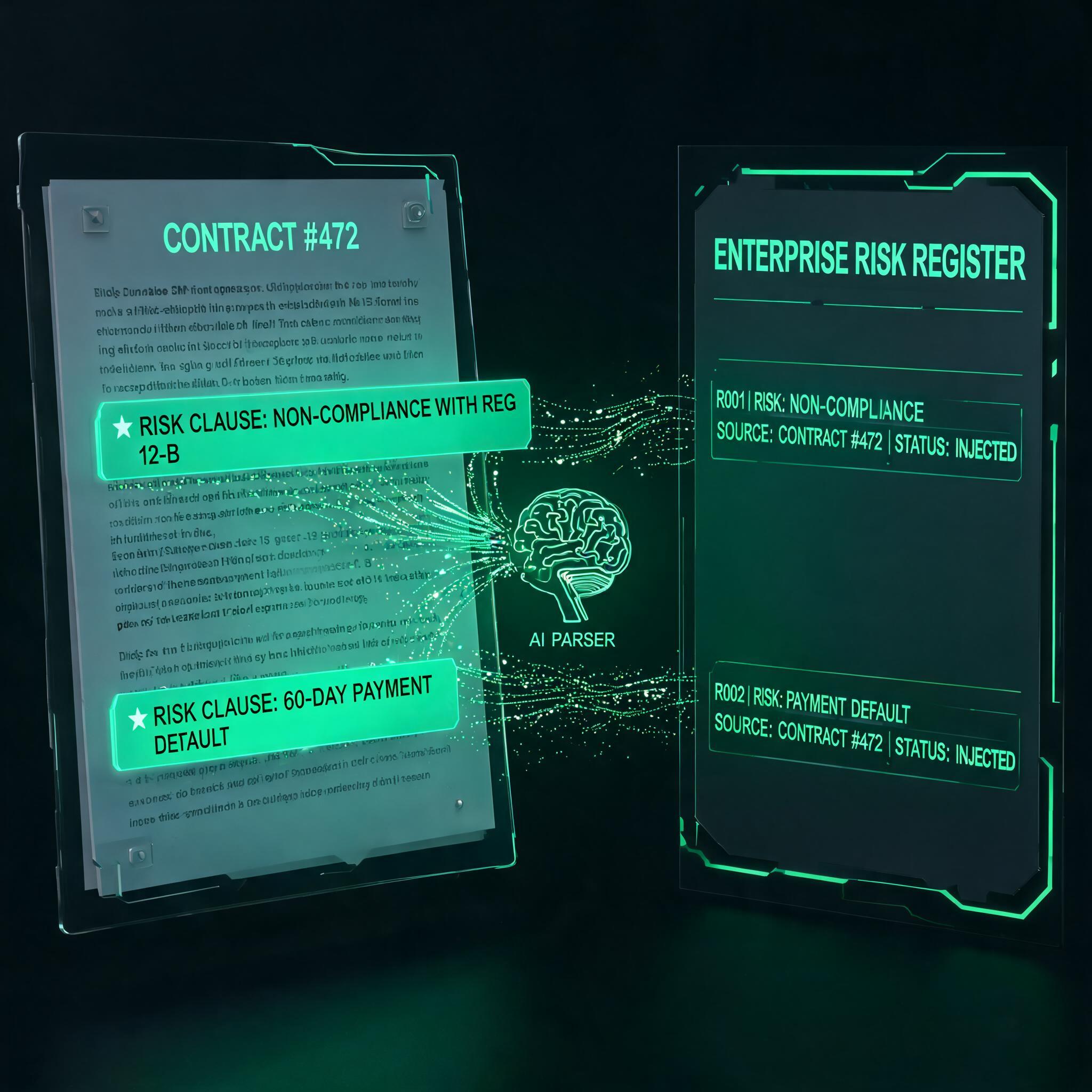
When contract data is natively integrated into the GRC platform through Automated Risk Injection, the audit trail is complete. The auditor can trace from the risk entry to the source clause, verify the risk classification methodology, confirm the control linkage, and review the monitoring evidence, all within a single system with a single audit log.
The objection I hear most often is: "We already have a CLM tool and a GRC platform. Can we not just integrate them?" The answer is technically yes and practically no, for reasons I have detailed elsewhere but will summarise here:
Data model mismatch: CLM tools model contracts (parties, dates, terms, status). GRC tools model risks (categories, scores, controls, owners). There is no natural mapping between a contract clause and a risk entry without a classification engine that understands both domains.
No shared taxonomy: The way a lawyer describes contract risk ("this indemnity is broad") is not the way a risk manager describes it ("high-impact financial risk with likelihood assessed at probable"). Translation requires a common taxonomy that neither system provides.
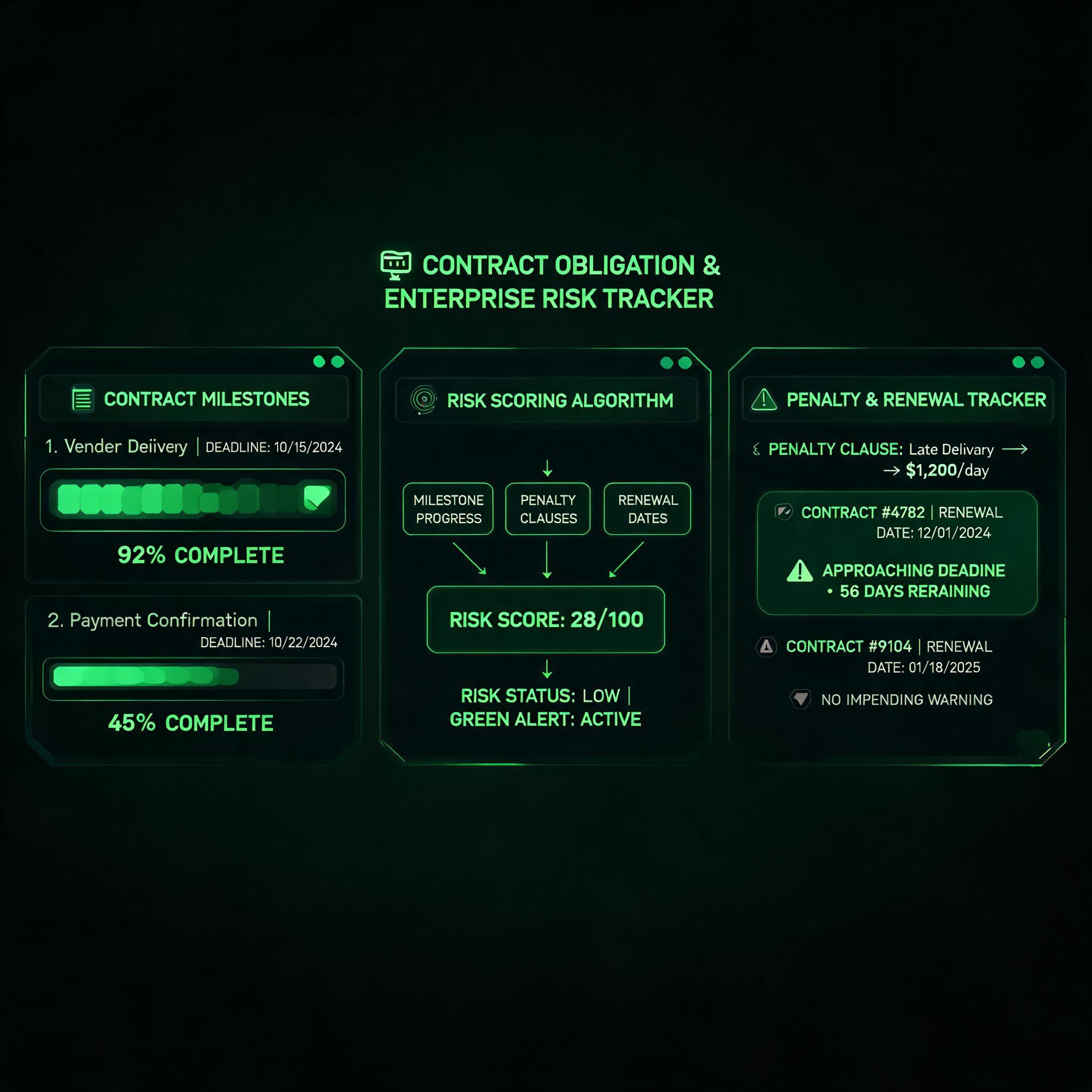
Lifecycle synchronisation: Contracts change over the course of their lifetime: amendments, variations, renewals, assignments. Each change potentially alters the risk profile. An integration that transfers data at the point of signing but does not update when the contract is amended creates a risk register that drifts further from reality with every contract change.
Maintenance cost: Point-to-point integrations between enterprise platforms require ongoing maintenance. When either vendor updates their API, the integration breaks. When the organisation changes its risk taxonomy, the mapping breaks. The total cost of ownership for a CLM-to-GRC integration often exceeds the cost of either platform individually.
The alternative is not integration. It is unification. A single platform where contract data and risk data share the same data model, the same taxonomy, the same workflow engine, and the same audit trail.
In this architecture, when a contract is entered into the system, its risk-relevant attributes are automatically classified against the enterprise risk taxonomy. Risk entries are automatically generated in the risk register with pre-populated fields: description, category, likelihood, impact, controls, owner, review date. When the contract is amended, the risk entries are automatically re-assessed. When the contract approaches renewal, the associated risks are automatically flagged for review. When the contract terminates, the associated risks are automatically closed.
This is what Automated Risk Injection delivers for contracts. It is not an integration between two systems. It is a single system that treats contracts and risks as two views of the same underlying governance data.
With contract risk inside the GRC platform, the board's risk dashboard changes fundamentally:
This is the difference between a board that governs based on complete information and a board that governs based on whatever the risk team had time to manually enter last quarter.
Contract risk does not belong outside your GRC platform. It belongs at the centre of it. Contracts are the mechanism through which your organisation accepts risk, commits to obligations, and creates compliance requirements. If that data is not in your GRC platform, your governance framework is incomplete by design.
The answer is not to integrate your CLM tool with your GRC platform. The answer is to use a platform where contracts and risks are part of the same architecture, connected by Automated Risk Injection, visible in the same dashboards, and auditable through the same trail.
Simplif-i was built for exactly this purpose. One platform. One data model. One risk framework. Every contract, every risk, every control, every audit trail: connected by design, not by middleware.
Compliance, simplif-i'd.
--- Source: https://simplif-i.com/api/blog/readable/contracts/why-contract-risk-belongs-in-grc-platform Web Version: https://simplif-i.com/blog/contracts/why-contract-risk-belongs-in-grc-platform © Simplif-i - Unified Business Management Platform