Every contract your organisation signs is a risk event. Every obligation you accept, every liability you assume, every penalty clause you agree to, every service level you commit to: these are risks that should appear in your enterprise risk register. In 2026, for most organisations, they do not.
I have audited contract management practices across dozens of organisations over the past two decades. The pattern is remarkably consistent. The legal team manages contracts in a contract lifecycle management (CLM) tool or, more commonly, in a shared drive with a naming convention that nobody follows consistently. The risk team manages the enterprise risk register in a GRC platform. The two systems have no connection. The two teams have no shared workflow. And the board receives a risk report that treats contract risk as a single line item rather than the complex, multi-layered exposure it actually represents.
This disconnect is not a process inefficiency. It is a governance failure. Let me explain why, and what the alternative looks like.
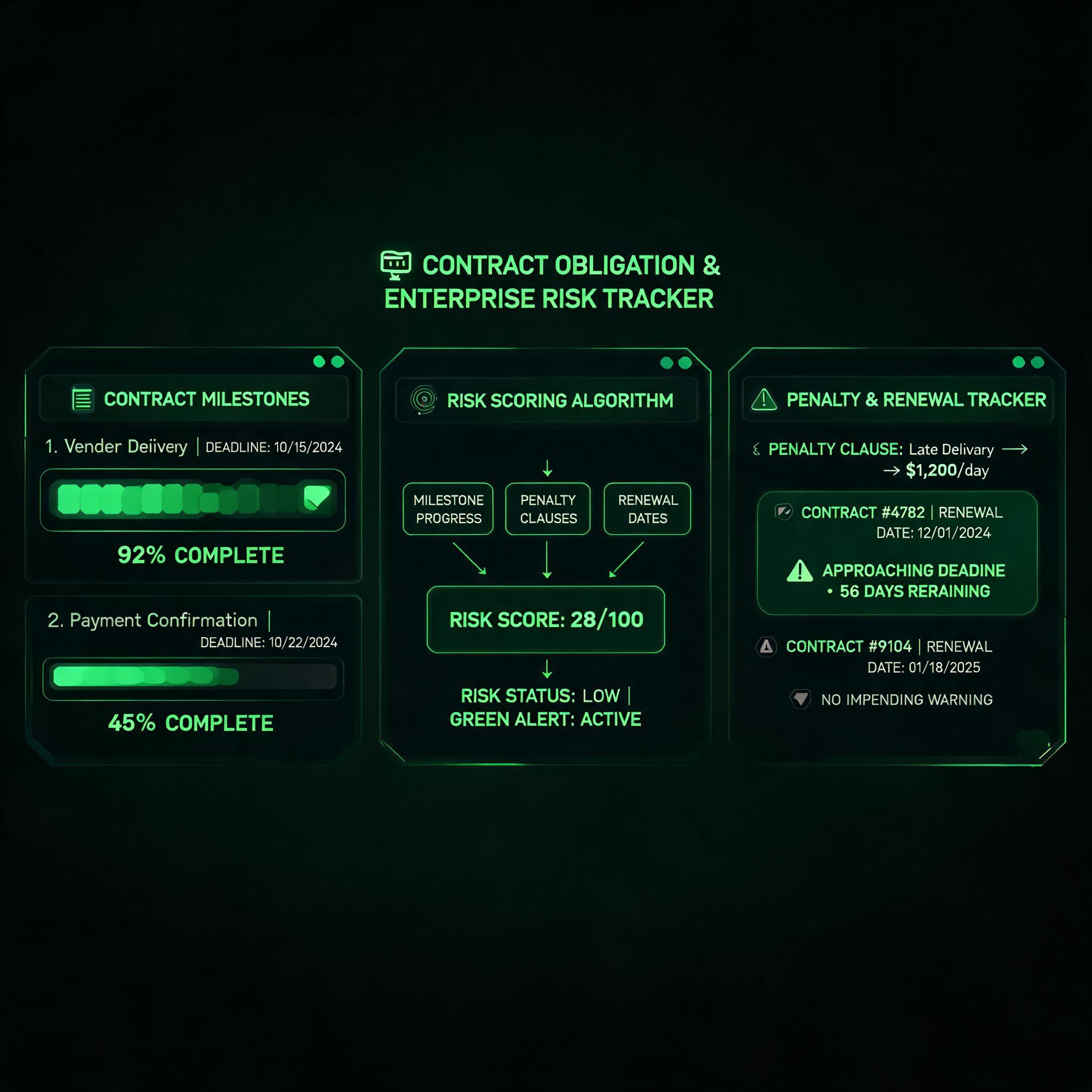
A mid-market organisation with 500 employees typically has between 200 and 800 active contracts at any given time. These include supplier agreements, customer contracts, employment contracts with key personnel, property leases, insurance policies, software licences, partnership agreements, and financing arrangements. Each contract contains obligations, deadlines, penalty provisions, indemnities, limitation of liability clauses, termination triggers, and change of control provisions.
The aggregate risk exposure embedded in these contracts dwarfs most other risk categories on the enterprise risk register. A single customer contract with an uncapped indemnity clause can create more financial exposure than the organisation's entire cybersecurity risk budget. A supplier contract with a 12-month notice period and no performance benchmarks can lock the organisation into a relationship that destroys value for a year after the problem is identified.
Yet in most organisations I audit, contract risk appears in the enterprise risk register as a generic entry: "Risk of contract non-performance" or "Risk of contractual dispute," rated as medium likelihood and medium impact, with a control described as "Legal team reviews contracts before signing." This tells the board nothing about the actual risk exposure. It is governance theatre.
The disconnection exists for four structural reasons:
Contract management is typically owned by the legal function, sometimes by procurement for supplier contracts or by commercial teams for customer contracts. Risk management is owned by a separate risk function, or by compliance, or by internal audit, or by the CFO's office. These teams have different reporting lines, different systems, different priorities, and different vocabularies. "Risk" to a contract manager means the chance of a dispute. "Risk" to an enterprise risk manager means a structured assessment of likelihood and impact against the organisation's risk appetite framework.
Contract lifecycle management tools (Ironclad, Juro, Agiloft, ContractPodAi) are designed to manage the drafting, negotiation, execution, and storage of contracts. They track contract status, key dates, and parties. They do not assess risk in the way a GRC platform does: they do not score likelihood and impact, they do not link to controls, they do not feed risk dashboards, and they do not support escalation workflows tied to risk thresholds.
GRC platforms (ServiceNow, Archer, Diligent) are designed to manage risks, controls, and compliance. They do not store contracts, parse contract clauses, track obligation deadlines, or manage contract renewals. The risk associated with a contract must be manually entered by someone who has read the contract, understood its risk implications, and translated them into the GRC platform's risk taxonomy.
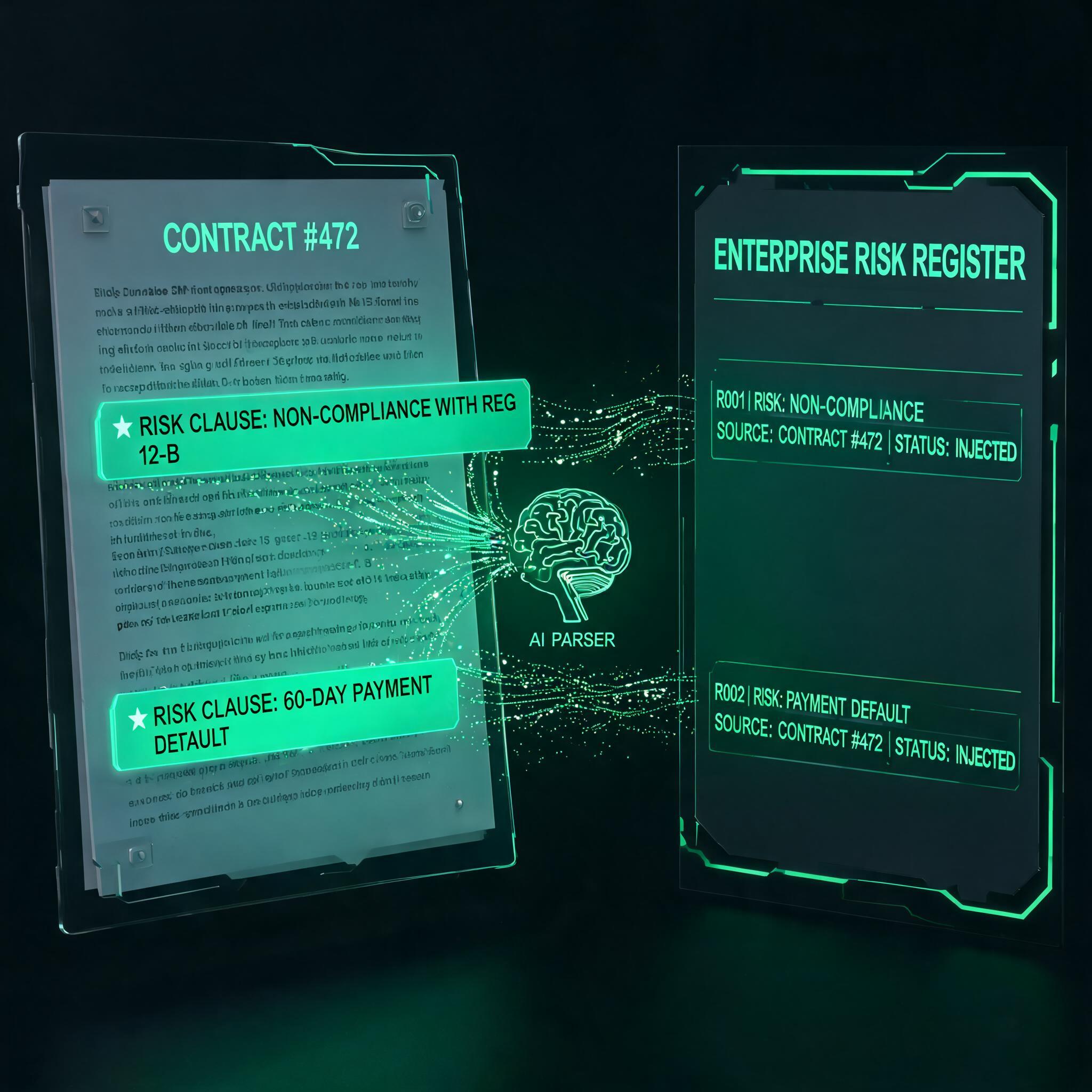
Even if someone wanted to manually create risk entries for every contract, the volume makes it impractical. An organisation with 400 active contracts, each containing an average of five risk-relevant clauses, would need to create, maintain, and review 2,000 risk entries linked to specific contract clauses. No risk team has the capacity for this. So they default to the generic "contract risk" entry and hope that the legal team is catching the important issues.
Contract risks are created at the point of signing but evolve over the contract lifecycle. A supplier contract that was low-risk at signing becomes high-risk when the supplier's financial position deteriorates. A customer contract that was standard at execution becomes material when the customer becomes the organisation's largest revenue source. These lifecycle changes are invisible to the risk register unless someone manually updates it, and they rarely do.
The consequences of the disconnect between contract management and enterprise risk are predictable and, in my experience, inevitable:
Blind spot during M&A: The acquiring company's due diligence team reviews the target's contracts during the deal process. Risk-relevant clauses are flagged in the due diligence report. After completion, the report goes into a filing cabinet (physical or digital) and the contract risks are never transferred into the acquiring group's risk register. Six months later, a change of control clause triggers in a material customer contract, and the group discovers it is about to lose 15% of the acquired entity's revenue.
Renewal trap: A supplier contract with an auto-renewal clause and a 90-day notice period renews automatically because no one was tracking the notice deadline. The contract is now locked in for another three years at terms that are 30% above market rate. The enterprise risk register shows no supplier concentration risk because the risk team was not aware of the contract terms.
Regulatory exposure: A data processing agreement with a third-party supplier does not meet the requirements of the UK GDPR because it was signed before the regulation applied and was never updated. The contract management system shows the contract as "active." The GRC platform shows data processing compliance as "green" because the control assessment tested the template DPA, not the actual executed agreements. The disconnect creates a compliance gap that only surfaces during a regulatory investigation.
Automated Risk Injection for contracts works by treating every contract as a risk source that continuously feeds the enterprise risk register. The architecture has four layers:
Every contract in the system has a structured profile that includes not just the commercial terms but the risk-relevant attributes: obligation types, liability caps, indemnity provisions, penalty clauses, termination triggers, change of control provisions, auto-renewal terms, notice periods, jurisdiction and governing law, and counterparty details. This is not free-text metadata. It is structured data that the risk engine can process.
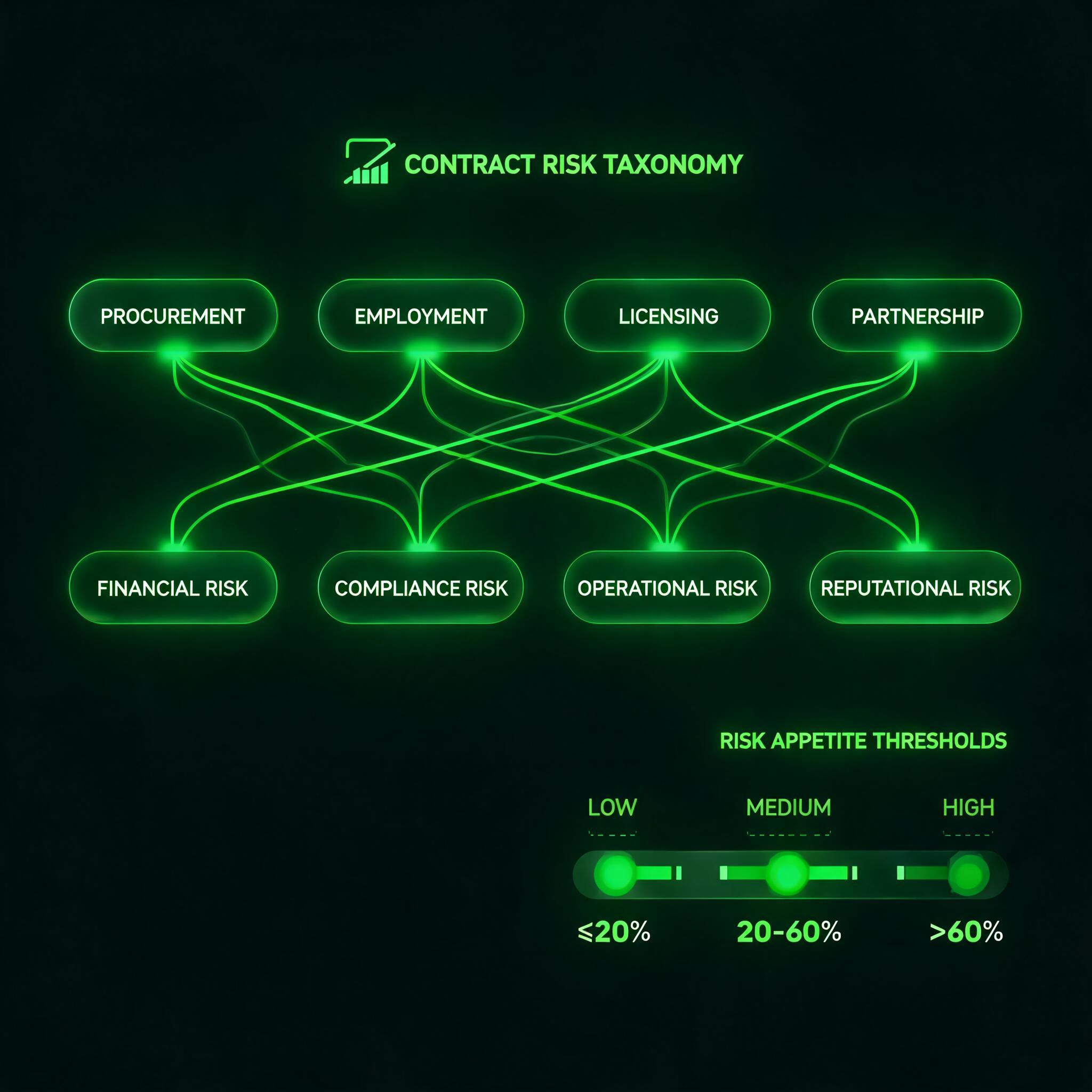
The system applies a risk taxonomy to each contract based on its attributes. A contract with an uncapped indemnity in favour of the counterparty is automatically classified as a high-impact financial risk. A contract with a change of control clause is automatically flagged as an M&A risk. A contract with a data processing component is automatically assessed against the data protection compliance framework. The classification is automatic, consistent, and auditable.
Each classified risk generates an entry in the enterprise risk register with pre-populated fields: risk description (derived from the contract clause), risk category (from the taxonomy), initial likelihood and impact scores (from the classification engine), linked controls (from the control framework), control owner (from the organisational structure), and review deadline (from the contract timeline). The risk entry is linked to the source contract so that any reviewer can navigate from the risk to the clause that generated it.
The system continuously monitors contract events that affect risk: approaching renewal dates, counterparty credit rating changes, obligation deadline approaches, performance metric breaches, and regulatory changes that affect contract compliance. Each event triggers a risk re-assessment. If a supplier's credit rating drops below the threshold defined in the risk appetite framework, the associated supplier concentration risk is automatically escalated.
Your organisation signs a new IT outsourcing agreement worth £2.4 million annually. The contract is entered into the system with its structured attributes. The risk classification engine identifies:
Four risk entries are automatically created in the enterprise risk register. Each is linked to the source contract, the relevant clauses, the applicable controls, and the designated control owners. The board risk dashboard updates in real time to reflect the new risk exposure. The audit committee can see exactly which contracts are generating which risks, at what severity, with what controls in place.
None of this required manual risk assessment. None of it required the risk team to read the contract. None of it required a quarterly reconciliation between the contract register and the risk register. The system did it automatically because the architecture was designed to treat contracts as risk inputs from the start.
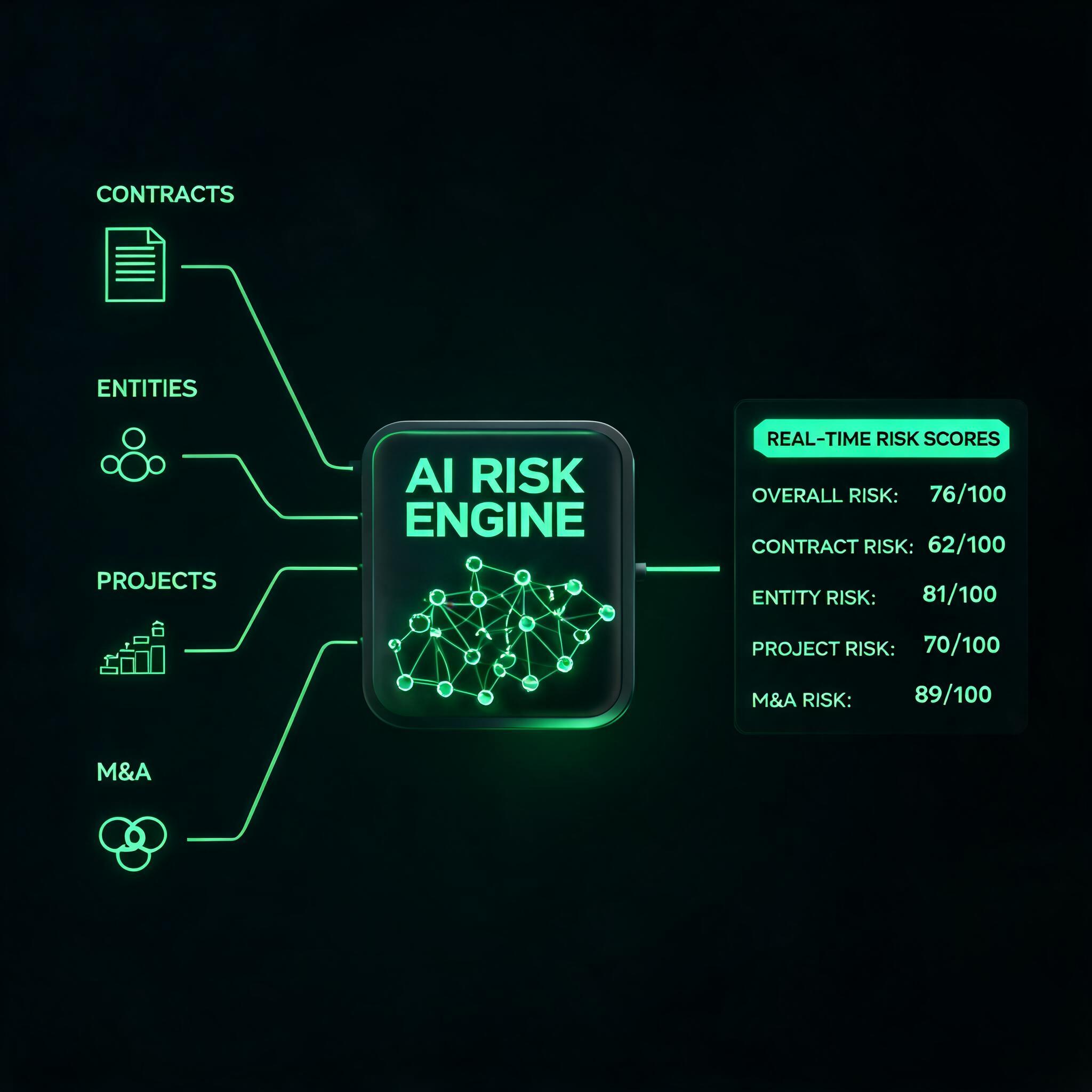
The regulatory environment in 2026 makes the connection between contract management and enterprise risk not just operationally sensible but increasingly mandatory. The UK's Senior Managers and Certification Regime (SM&CR) requires senior managers to take reasonable steps to manage the risks associated with their areas of responsibility. If contract risk is not visible in the enterprise risk register, senior managers cannot demonstrate they are managing it. The FCA's operational resilience framework requires firms to identify important business services and map the resources that support them, including third-party contracts. If contract data is not connected to risk data, the operational resilience assessment is incomplete.
The direction of travel is clear: regulators expect organisations to understand and manage the risk embedded in their contractual relationships. The organisations that connect contract management to enterprise risk systematically, automatically, and in real time will be in a demonstrably stronger position than those that continue to manage contracts and risks in separate silos.
Your contracts are your largest source of unmanaged risk. Not because the risks are not there, but because your systems are not designed to see them. Connecting contract management to enterprise risk is not an integration project. It is an architecture decision. You need a platform where contracts and risks share a data model, where contract events automatically generate risk entries, and where the board sees the full picture without waiting for a quarterly reconciliation that never quite happens.
That is what Automated Risk Injection delivers. That is what Simplif-i was built to do.
Compliance, simplif-i'd.
--- Source: https://simplif-i.com/api/blog/readable/contracts/connect-contract-management-to-enterprise-risk Web Version: https://simplif-i.com/blog/contracts/connect-contract-management-to-enterprise-risk © Simplif-i - Unified Business Management Platform